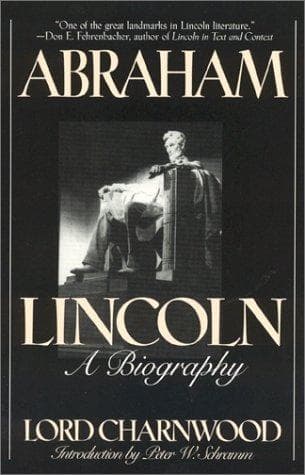
Abraham LincolnCharnwood, Godfrey Rathbone Benson, Baron
History
Abraham Lincoln
Charnwood, Godfrey Rathbone Benson, Baron
Lincoln, Abraham, 1809-1865; Presidents -- United States -- Biography
business, he then said, to save the Union if he could; "if I could save
the Union by emancipating all the slaves I would do so; if I could save
it by emancipating none of them, I would do it; if I could save it by
emancipating some and not others, I would do that too." But, as in the
letter at the beginning of this chapter he called Speed to witness, his
forbearance with slavery cost him real pain, and we shall misread both
his policy as President and his character as a man if we fail to see
that in the bottom of his mind he felt this forbearance to be required
by the very same principles which roused him against the extension of
the evil. Years before, he had written to an Abolitionist
correspondent that respect for the rights of the slave States was due
not only to the Constitution but, "as it seems to me, in a sense to
freedom itself." Negro slavery was not the only important issue, nor
was it an isolated issue. What really was in issue was the continuance
of the nation "dedicated," as he said on a great occasion, "to the
proposition that all men are equal," a nation founded by the Union of
self-governing communities, some of which lagged far behind the others
in applying in their own midst the elementary principles of freedom,
but yet a nation actuated from its very foundation in some important
respects by the acknowledgment of human rights.
The practical policy, then, on which his whole efforts were
concentrated consisted in this single point--the express recognition of
the essential evil of slavery by the enactment that it should not
spread further in the Territories subject to the Union. If slavery
were thus shut up within a ring fence and marked as a wrong thing which
the Union as a whole might tolerate but would not be a party to,
emancipation in the slave States would follow in course of time. It
would come about, Lincoln certainly thought, in a way far better for
the slaves as well as for their masters, than any forced liberation.
He was content to wait for it. "I do not mean that when it takes a
turn towards ultimate extinction, it will be in a day, nor in a year,
nor in two years. I do not suppose that in the most peaceful way
ultimate extinction would occur in less than a hundred years at least,
but that it will occur in the best way for both races in God's own good
time I have no doubt." If we wonder whether this policy, if soon
enough adopted by the Union as a whole, would really have brought on
emancipation in the South, the best answer is that, when the policy did
receive national sanction by the election of Lincoln, the principal
slave States themselves instinctively recognised it as fatal to slavery.
Public-domain text, read in full here on John Shaqi.
Reviews
Reviews
No reviews yet
Be the first to share your thoughts on this work.
Elsewhere in the archive
Join the Discussion
Join the discussion
Sign in to leave a comment or review.
Sign InorCreate an account