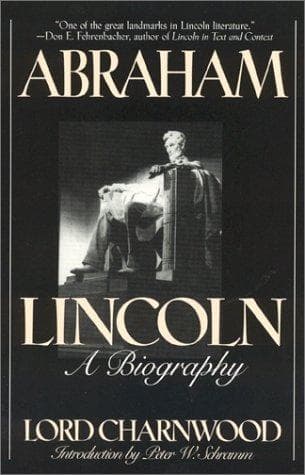
Abraham LincolnCharnwood, Godfrey Rathbone Benson, Baron
History
Abraham Lincoln
Charnwood, Godfrey Rathbone Benson, Baron
Lincoln, Abraham, 1809-1865; Presidents -- United States -- Biography
On the whole the earthen vessel in which he carried his treasure of
clear thought and clean feelings appears to have enhanced its flavour.
There was at any rate nothing outward about him that aroused the
passion of envy. A few peculiarly observant men were immediately
impressed with his distinction, but there is no doubt that to the
ordinary stranger he appeared as a very odd fish. "No portraits that I
have ever seen," writes one, "do justice to the awkwardness and
ungainliness of his figure." Its movements when he began to speak
rather added to its ungainliness, and, though to a trained actor his
elocution seemed perfect, his voice when he first opened his mouth
surprised and jarred upon the hearers with a harsh note of curiously
high pitch. But it was the sort of oddity that arrests attention, and
people's attention once caught was apt to be held by the man's
transparent earnestness. Soon, as he lost thought of himself in his
subject, his voice and manner changed; deeper notes, of which friends
record the beauty, rang out, the sad eyes kindled, and the tall, gaunt
figure, with the strange gesture of the long, uplifted arms, acquired
even a certain majesty. Hearers recalled afterwards with evident
sincerity the deep and instantaneous impression of some appeal to
simple conscience, as when, "reaching his hands towards the stars of
that still night," he proclaimed, "in some things she is certainly not
my equal, but in her natural right to eat the bread that she has earned
with the sweat of her brow, she is my equal, and the equal of Judge
Douglas, and the equal of any man." Indeed, upon a sympathetic
audience, already excited by the occasion, he could produce an effect
which the reader of his recorded speeches would hardly believe. Of his
speech at an early state convention of the Republican party there is no
report except that after a few sentences every reporter laid down his
pen for the opposite of the usual reason, and, as he proceeded, "the
audience arose from their chairs and with pale faces and quivering lips
pressed unconsciously towards him." And of his speech on another
similar occasion several witnesses seem to have left descriptions
hardly less incongruous with English experience of public meetings. If
we credit him with these occasional manifestations of electric
oratory--as to which it is certain that his quiet temperament did at
times blaze out in a surprising fashion--it is not to be thought that
he was ordinarily what could be called eloquent; some of his speeches
are commonplace enough, and much of his debating with Douglas is of a
drily argumentative kind that does honour to the mass meetings which
heard it gladly. But the greatest gift of the orator he did possess;
the personality behind the words was felt. "Beyond and above all
skill," says the editor of a great paper who heard him at Peoria, "was
the overwhelming conviction imposed upon the audience that the speaker
Public-domain text, read in full here on John Shaqi.
Reviews
Reviews
No reviews yet
Be the first to share your thoughts on this work.
Elsewhere in the archive
Join the Discussion
Join the discussion
Sign in to leave a comment or review.
Sign InorCreate an account