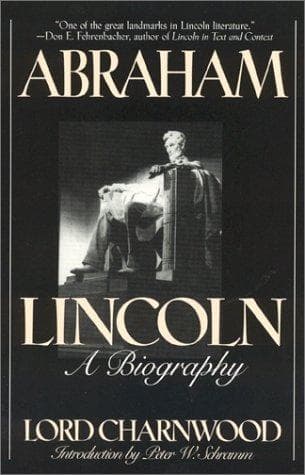
Abraham LincolnCharnwood, Godfrey Rathbone Benson, Baron
History
Abraham Lincoln
Charnwood, Godfrey Rathbone Benson, Baron
Lincoln, Abraham, 1809-1865; Presidents -- United States -- Biography
himself was charged with an irresistible and inspiring duty to his
fellow men."
One fact about the method of his speaking is easily detected. In
debate, at least, he had no use for perorations, and the reader who
looks for them will often find that Lincoln just used up the last few
minutes in clearing up some unimportant point which he wanted to
explain only if there was time for it. We associate our older
Parliamentary oratory with an art which keeps the hearer pleasedly
expectant rather than dangerously attentive, through an argument which
if dwelt upon might prove unsubstantial, secure that it all leads in
the end to some great cadence of noble sound. But in Lincoln's
argumentative speeches the employment of beautiful words is least
sparing at the beginning or when he passes to a new subject. It seems
as if he deliberately used up his rhetorical effects at the outset to
put his audience in the temper in which they would earnestly follow him
and to challenge their full attention to reasoning which was to satisfy
their calmer judgment. He put himself in a position in which if his
argument were not sound nothing could save his speech from failure as a
speech. Perhaps no standing epithet of praise hangs with such a weight
on a man's reputation as the epithet "honest." When the man is proved
not to be a fraud, it suggests a very mediocre virtue. But the method
by which Lincoln actually confirmed his early won and dangerous
reputation of honesty was a positive and potent performance of rare
distinction. It is no mean intellectual and spiritual achievement to
be as honest in speech with a crowd as in the dearest intercourse of
life. It is not, of course, pretended that he never used a fallacious
argument or made an unfair score--he was entirely human. But this is
the testimony of an Illinois political wire-puller to Lincoln: "He was
one of the shrewdest politicians in the State. Nobody had more
experience in that way. Nobody knew better what was passing in the
minds of the people. Nobody knew better how to turn things to
advantage politically." And then he goes on--and this is really the
sum of what is to be said of his oratory: "He could not cheat people
out of their votes any more than he could out of their money."
3. _Lincoln against Douglas_.
It has now to be told how the contest with Douglas which concluded
Lincoln's labours in Illinois affected the broad stream of political
events in America as a whole. Lincoln, as we know, was still only a
local personage; Illinois is a State bigger than Ireland, but it is
only a little part and was still a rather raw and provincial part of
the United States; but Douglas had for years been a national personage,
for a time the greatest man among the Democrats, and now, for a reason
which did him honour, he was in disgrace with many of his party and on
the point of becoming the hero of all moderate Republicans.
Public-domain text, read in full here on John Shaqi.
Reviews
Reviews
No reviews yet
Be the first to share your thoughts on this work.
Elsewhere in the archive
Join the Discussion
Join the discussion
Sign in to leave a comment or review.
Sign InorCreate an account