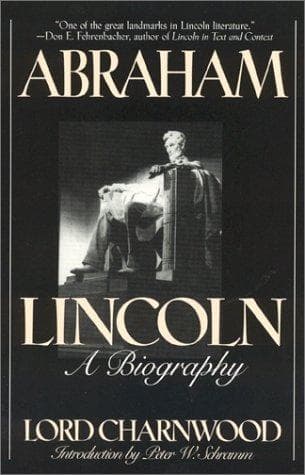
Abraham LincolnCharnwood, Godfrey Rathbone Benson, Baron
History
Abraham Lincoln
Charnwood, Godfrey Rathbone Benson, Baron
Lincoln, Abraham, 1809-1865; Presidents -- United States -- Biography
that the right to a slave is just one form of the ordinary right to
property once became firmly fixed in American jurisprudence it is hard
to see how any laws prohibiting slavery could have continued to be held
constitutional except in States which were free States when the
Constitution was adopted. Of course, a State like New York where
slaves were industrially useless would not therefore have been filled
with slave plantations, but, among a loyally minded people, the
tradition which reprobated slavery would have been greatly weakened.
The South would have been freed from the sense that slavery was a
doomed institution. If attempts to plant slavery further in the West
with profit failed, there was Cuba and there was Central America, on
which filibustering raids already found favour in the South, and in
which the national Government might be led to adopt schemes of conquest
or annexation. Moreover, it was avowed by leaders like Jefferson Davis
that though it might be impracticable to hope for the repeal of the
prohibition of the slave trade, at least some relaxation of its
severity ought to be striven for, in the interest of Texas and New
Mexico and of possible future Territories where there might be room for
more slaves. Such were the views of the leaders whose influence
preponderated with the present President and in the main with the
present Congress. When Lincoln judged that a determined stand against
their policy was required, and further that no such stand could be
possible to a party which had embraced Douglas with his principle, "I
care not whether slavery be voted up or voted down," there is no doubt
now that he was right and the great body of Republican authority
opposed to him wrong.
When Lincoln and his friends in Illinois determined to fight Douglas,
it became impossible for the Republican party as a whole to fall far
behind them. This was in itself at that crisis an important thing.
Lincoln added greatly to its importance by the opening words in the
first speech of his campaign. They were the most carefully prepared
words that he had yet spoken, and the most momentous that he had spoken
till now or perhaps ever spoke. There is nothing in them for which
what has been said of the situation and of his views will not have
prepared us, and nothing which thousands of men might not have said to
one another in private for a year or two before. But the first public
avowal by a responsible man in trenchant phrase, that a grave issue has
been joined upon which one party or the other must accept entire
defeat, may be an event of great and perilous consequence.
Public-domain text, read in full here on John Shaqi.
Reviews
Reviews
No reviews yet
Be the first to share your thoughts on this work.
Elsewhere in the archive
Join the Discussion
Join the discussion
Sign in to leave a comment or review.
Sign InorCreate an account