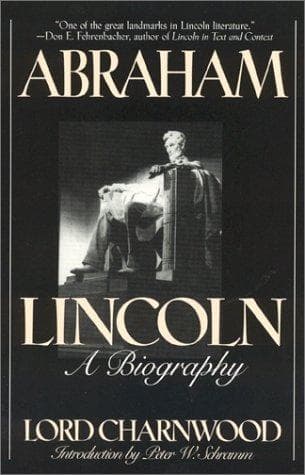
Abraham LincolnCharnwood, Godfrey Rathbone Benson, Baron
History
Abraham Lincoln
Charnwood, Godfrey Rathbone Benson, Baron
Lincoln, Abraham, 1809-1865; Presidents -- United States -- Biography
He said: "If we could first know where we are and whither we are
tending, we could better judge what to do and how to do it. We are now
far into the fifth year since a policy was initiated with the avowed
object, and confident promise, of putting an end to slavery agitation.
Under the operation of that policy, that agitation has not only not
ceased, but has constantly augmented. In my opinion it will not cease
until a crisis shall have been reached and passed. 'A house divided
against itself cannot stand.' I believe this Government cannot endure
permanently half slave and half free. I do not expect the Union to be
dissolved--I do not expect the house to fall--but I do expect that it
will cease to be divided. It will become all one thing or all the
other. Either the opponents of slavery will arrest the further spread
of it and place it where the public mind shall rest in the belief that
it is in course of ultimate extinction, or its advocates will push it
forward till it shall become lawful alike in all the States, old as
well as new--North as well as South."
It may perhaps be said that American public opinion has in the past
been very timid in facing clear-cut issues. But, as has already been
observed, an apt phrase crystallising the unspoken thought of many is
even more readily caught up in America than anywhere else; so, though
but few people in States at a distance paid much attention to the rest
of the debates, or for a while again to Lincoln, the comparison of the
house divided against itself produced an effect in the country which
did not wear out. In this whole passage, moreover, Lincoln had
certainly formulated the question before the nation more boldly, more
clearly, more truly than any one before. It is impossible to estimate
such influences precisely, but this was among the speeches that rank as
important actions, and the story, most characteristic of the speaker,
which lay behind it, is worth relating in detail. Lincoln had actually
in a speech in 1856 declared that the United States could not long
endure half slave and half free. "What in God's name," said some
friend after the meeting, "could induce you to promulgate such an
opinion?" "Upon my soul," he said, "I think it is true," and he could
not be argued out of this opinion. Finally the friend protested that,
true or not, no good could come of spreading this opinion abroad, and
after grave reflection Lincoln promised not to utter it again for the
present. Now, in 1858, having prepared his speech he read it to
Herndon. Herndon questioned whether the passage on the divided house
was politic. Lincoln said: "I would rather be defeated with this
expression in my speech, and uphold and discuss it before the people,
than be victorious without it." Once more, just before he delivered
it, he read it over to a dozen or so of his closest supporters, for it
was his way to discuss his intentions fully with friends, sometimes
Public-domain text, read in full here on John Shaqi.
Reviews
Reviews
No reviews yet
Be the first to share your thoughts on this work.
Elsewhere in the archive
Join the Discussion
Join the discussion
Sign in to leave a comment or review.
Sign InorCreate an account