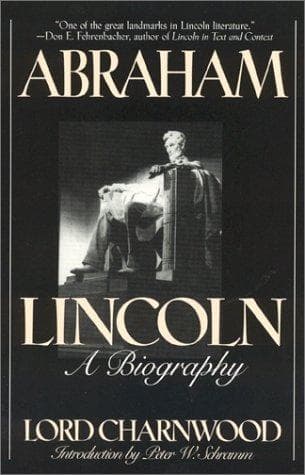
Abraham LincolnCharnwood, Godfrey Rathbone Benson, Baron
History
Abraham Lincoln
Charnwood, Godfrey Rathbone Benson, Baron
Lincoln, Abraham, 1809-1865; Presidents -- United States -- Biography
For the next few months the excitements of the great political world
concern this biography little. There was strife between Davis and
Douglas in the Senate. At a meeting strong against slavery, Seward
regained courage from the occasion and roused the North with grave and
earnest words about the "irrepressible conflict." The "underground
railway," or chain of friendly houses by which fugitive slaves were
stealthily passed on to Canada, became famous. Methodist professors
riotously attempted to rescue an arrested fugitive at Oberlin. A
Southern grand jury threw out the bill of indictment against a
slave-trading crew caught red-handed. In California Democrats
belonging to what was nicknamed "the chivalry" forced upon Senator
Broderick, a literally democratic Irishman and the bravest of the
Democrats who stood out for fair treatment to Kansas, a duel in which
he might fairly be said to have been murdered. The one event which
demands more than allusion was the raid and the death of John Brown.
John Brown, in whom Puritan religion, as strict as that of his
ancestors on the _Mayflower_, put forth gentler beauties of character
than his sanguinary mission may suggest, had been somewhat of a failure
as a scientific farmer, but as a leader of fighting men in desperate
adventure only such men as Drake or Garibaldi seem to have excelled
him. More particularly in the commotions in Kansas he had led forays,
slain ruthlessly, witnesses dry-eyed the deaths of several of his tall,
strong sons, and as a rule earned success by cool judgment--all, as he
was absolutely sure, at the clear call of God. In October, 1859--how
and with whose help the stroke was prepared seems to be a question of
some mystery--John Brown, gathering a little band of Abolitionists and
negroes, invaded the slave States and seized the United States arsenal
at Harper's Ferry in Virginia. In the details, which do not matter, of
this tiny campaign, John Brown seems, for the first time in his life,
to have blundered badly. This was the only thing that lay upon his
conscience towards the last. What manner of success he can have
expected does not appear; most likely he had neither care nor definite
expectation as to the result. The United States troops under Robert
Lee, soon to be famous, of course overcame him quickly. One of his
prisoners describes how he held out to the last; a dead son beside him;
one hand on the pulse of a dying son, his rifle in the other. He was
captured, desperately wounded. Southerners could not believe the fact
that Brown had not contemplated some hideous uprising of slaves against
their wives and children, but he only wished to conquer them with the
sword of the Lord and of Gideon, quietly freeing slaves as he went. So
naturally there was talk of lynching, but the Virginian gentlemen
concerned would not have that. Governor Wise, of Virginia, had some
talk with him and justified his own high character rather than Brown's
Public-domain text, read in full here on John Shaqi.
Reviews
Reviews
No reviews yet
Be the first to share your thoughts on this work.
Elsewhere in the archive
Join the Discussion
Join the discussion
Sign in to leave a comment or review.
Sign InorCreate an account