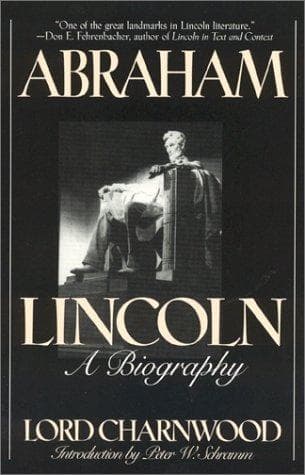
Abraham LincolnCharnwood, Godfrey Rathbone Benson, Baron
History
Abraham Lincoln
Charnwood, Godfrey Rathbone Benson, Baron
Lincoln, Abraham, 1809-1865; Presidents -- United States -- Biography
invincible candidate for the South to support in 1860, and it must have
told in his favour that his offence then had been one of plain honesty.
But in this fresh offence the Southern leaders had some cause to accuse
him of double dealing, and they swore he should not be President.
A majority of the new Illinois Legislature returned Douglas to the
Senate. Lincoln, however, had an actual majority of the votes of the
whole State. Probably also he had gained a hold on Illinois for the
future out of all proportion to the actual number of votes then given
against the popular Douglas, and above all he had gathered to him a
band of supporters who had unbounded belief in him. But his fall for
the moment was little noticed or regretted outside Illinois, or at any
rate in the great Eastern States, to which Illinois was, so to speak,
the provinces and he a provincial attorney. His first words in the
campaign had made a stir, but the rest of his speeches in these long
debates could not be much noticed at a distance. Douglas had won, and
the presumption was that he had proved himself the better man. Lincoln
had performed what, apart from results, was a work of intellectual
merit beyond the compass of any American statesman since Hamilton;
moreover, as can now be seen, there had been great results; for, first,
the young Republican party had not capitulated and collapsed, and,
then, the great Democratic party, established in power, in
indifference, and in complicity with wrong, was split clean in two.
But these were not results that could be read yet awhile in election
figures. Meanwhile the exhausted Lincoln reconciled himself for the
moment to failure. As a private man he was thoroughly content that he
could soon work off his debt for his election expenses, could earn
about 500 pounds a year, and be secure in the possession of the little
house and the 2,000 pounds capital which was "as much as any man ought
to have." As a public man he was sadly proud that he had at least
"said some words which may bear fruit after I am forgotten."
Persistent melancholy and incurable elasticity can go together, and
they make a very strong combination. The tone of resignation had not
passed away from his comparatively intimate letters when he was writing
little notes to one political acquaintance and another inciting them to
look forward to the fun of the next fight.
4. _John Brown_.
Public-domain text, read in full here on John Shaqi.
Reviews
Reviews
No reviews yet
Be the first to share your thoughts on this work.
Elsewhere in the archive
Join the Discussion
Join the discussion
Sign in to leave a comment or review.
Sign InorCreate an account