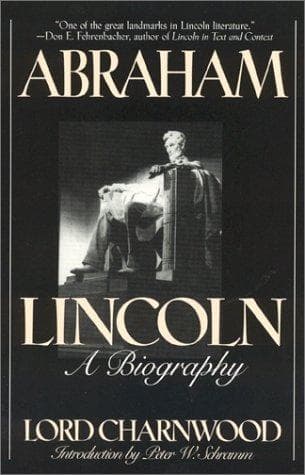
Abraham LincolnCharnwood, Godfrey Rathbone Benson, Baron
History
Abraham Lincoln
Charnwood, Godfrey Rathbone Benson, Baron
Lincoln, Abraham, 1809-1865; Presidents -- United States -- Biography
In December, 1859, he made a number of speeches in Kansas and elsewhere
in the West, and in February, 1860, he gave a memorable address in the
Cooper Institute in New York before as consciously intellectual an
audience as could be collected in that city, proceeding afterwards to
speak in several cities of New England. His appearance at the Cooper
Institute, in particular, was a critical venture, and he knew it.
There was natural curiosity about this untutored man from the West. An
exaggerated report of his wit prepared the way for probable
disappointment. The surprise which awaited his hearers was of a
different kind; they were prepared for a florid Western eloquence
offensive to ears which were used to a less spontaneous turgidity; they
heard instead a speech with no ornament at all, whose only beauty was
that it was true and that the speaker felt it. The single flaw in the
Cooper Institute speech has already been cited, the narrow view of
Western respectability as to John Brown. For the rest, this speech,
dry enough in a sense, is an incomparably masterly statement of the
then political situation, reaching from its far back origin to the
precise and definite question requiring decision at that moment. Mr.
Choate, who as a young man was present, set down of late years his
vivid recollection of that evening. "He appeared in every sense of the
word like one of the plain people among whom he loved to be counted.
At first sight there was nothing impressive or imposing about him; his
clothes hung awkwardly on his giant frame; his face was of a dark
pallor without the slightest tinge of colour; his seamed and rugged
features bore the furrows of hardship and struggle; his deep-set eyes
looked sad and anxious; his countenance in repose gave little evidence
of the brilliant power which raised him from the lowest to the highest
station among his countrymen; as he talked to me before the meeting he
seemed ill at ease." We know, as a fact, that among his causes of
apprehension, he was for the first time painfully conscious of those
clothes. "When he spoke," proceeds Mr. Choate, "he was transformed;
his eye kindled, his voice rang, his face shone and seemed to light up
the whole assembly. For an hour and a half he held his audience in the
hollow of his hand. His style of speech and manner of delivery were
severely simple. What Lowell called 'the grand simplicities of the
Bible,' with which he was so familiar, were reflected in his discourse.
. . . It was marvellous to see how this untutored man, by mere
self-discipline and the chastening of his own spirit, had outgrown all
meretricious arts, and found his way to the grandeur and strength of
absolute simplicity."
Public-domain text, read in full here on John Shaqi.
Reviews
Reviews
No reviews yet
Be the first to share your thoughts on this work.
Elsewhere in the archive
Join the Discussion
Join the discussion
Sign in to leave a comment or review.
Sign InorCreate an account