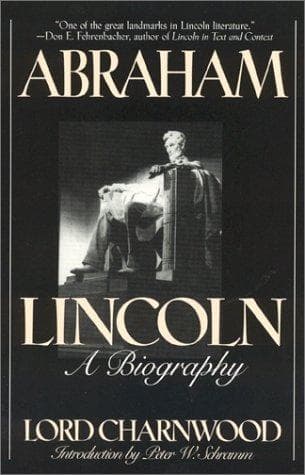
Abraham LincolnCharnwood, Godfrey Rathbone Benson, Baron
History
Abraham Lincoln
Charnwood, Godfrey Rathbone Benson, Baron
Lincoln, Abraham, 1809-1865; Presidents -- United States -- Biography
The newspapers of the day after this speech confirm these reverent
reminiscences. On this, his first introduction to the cultivated world
of the East, Lincoln's audience were at the moment and for the moment
conscious of the power which he revealed. The Cooper Institute speech
takes the plain principle that slavery is wrong, and draws the plain
inference that it is idle to seek for common ground with men who say it
is right. Strange but tragically frequent examples show how rare it is
for statesmen in times of crisis to grasp the essential truth so
simply. It is creditable to the leading men of New York that they
recognised a speech which just at that time urged this plain thing in
sufficiently plain language as a very great speech, and had an inkling
of great and simple qualities in the man who made it. It is not
specially discreditable that very soon and for a long while part of
them, or of those who were influenced by their report, reverted to
their former prejudices in regard to Lincoln. When they saw him thrust
by election managers into the Presidency, very few indeed of what might
be called the better sort believed, or could easily learn, that his
great qualities were great enough to compensate easily for the many
things he lacked. This specially grotesque specimen of the wild West
was soon seen not to be of the charlatan type; as a natural alternative
he was assumed to be something of a simpleton. Many intelligent men
retained this view of him throughout the years of his trial, and, only
when his triumph and tragic death set going a sort of Lincoln myth,
began to recollect that "I came to love and trust him even before I
knew him," or the like. A single speech like this at the Cooper
Institute might be enough to show a later time that Lincoln was a man
of great intellect, but it could really do little to prepare men in the
East for what they next heard of him.
Public-domain text, read in full here on John Shaqi.
Reviews
Reviews
No reviews yet
Be the first to share your thoughts on this work.
Elsewhere in the archive
Join the Discussion
Join the discussion
Sign in to leave a comment or review.
Sign InorCreate an account