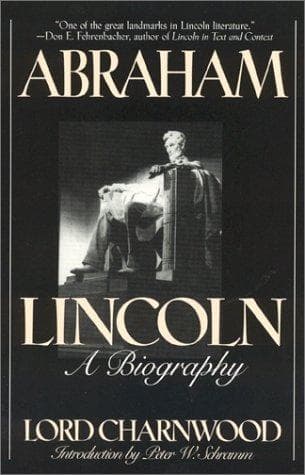
Abraham LincolnCharnwood, Godfrey Rathbone Benson, Baron
History
Abraham Lincoln
Charnwood, Godfrey Rathbone Benson, Baron
Lincoln, Abraham, 1809-1865; Presidents -- United States -- Biography
Democratic Conventions at Baltimore, a Northern and a Southern,
nominated, as their respective candidates, Stephen Douglas, the obvious
choice with whom, if the Southerners had cared to temporise further, a
united Democratic party could have swept the polls, and John C.
Breckinridge of Kentucky, a gentleman not otherwise known than as the
standard bearer on this great occasion of the undisguised and
unmitigated claims of the slave owners.
Thus it was that the American Democratic party forfeited power for
twenty-four years, divided between the consistent maintenance of a
paradox and the adroit maintenance of inconsistency. Another party in
this election demands a moment's notice. A Convention of delegates,
claiming to represent the old Whigs, met also at Baltimore and declared
merely that it stood for "the Constitution of the country, the union of
the States, and the enforcement of the laws." They nominated for the
Presidency John Bell of Tennessee, and for the Vice-Presidency Edward
Everett. This latter gentleman was afterwards chosen as the orator of
the day at the ceremony on the battlefield of Gettysburg when Lincoln's
most famous speech was spoken. He was a travelled man and a scholar;
he was Secretary of State for a little while under Fillmore, and dealt
honestly and firmly with the then troublous question of Cuba. His
orations deserve to be looked at, for they are favourable examples of
the eloquence which American taste applauded, and as such they help to
show how original Lincoln was in the simpler beauty of his own simpler
diction. In justice to the Whigs, let it be noted that they declared
for the maintenance of the Union, committing themselves with decision
on the question of the morrow; but it was a singular platform that
resolutely and totally ignored the only issue of the day. Few
politicians can really afford to despise either this conspicuously
foolish attempt to overcome a difficulty by shutting one's eyes to it,
or the more plausible proposal of the Northern Democrats to continue
temporising with a movement for slavery in which they were neither bold
enough nor corrupted enough to join. The consequences, now known to
us, of a determined stand against the advance of slavery were
instinctively foreseen by these men, and they cannot be blamed for
shrinking from them. Yet the historian now, knowing that those
consequences exceeded in terror all that could have been foreseen, can
only agree with the judgment expressed by Lincoln in one of his Kansas
speeches: "We want and must have a national policy as to slavery which
deals with it as being a wrong. Whoever would prevent slavery becoming
national and perpetual yields all when he yields to a policy which
treats it either as being right, or as being a matter of indifference."
The Republican party had been founded upon just this opinion.
Electoral victory was now being prepared for it, not because a majority
Public-domain text, read in full here on John Shaqi.
Reviews
Reviews
No reviews yet
Be the first to share your thoughts on this work.
Elsewhere in the archive
Join the Discussion
Join the discussion
Sign in to leave a comment or review.
Sign InorCreate an account