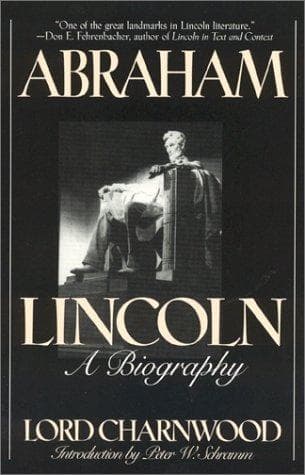
Abraham LincolnCharnwood, Godfrey Rathbone Benson, Baron
History
Abraham Lincoln
Charnwood, Godfrey Rathbone Benson, Baron
Lincoln, Abraham, 1809-1865; Presidents -- United States -- Biography
was likely yet to take so resolute a view, but because its effective
opponents were divided between those who had gone the length of calling
slavery right and those who strove to treat it as indifferent. The
fate of America may be said to have depended in the early months of
1860 on whether the nominee of the Republican party was a man who would
maintain its principles with irresolution, or with obstinacy, or with
firm moderation.
When it had first been suggested to Lincoln in the course of 1859 that
he might be that nominee he said, "I do not think myself fit for the
Presidency." This was probably his sincere opinion at the moment,
though perhaps the moment was one of dejection. In any case his
opinion soon changed, and though it is not clear whether he encouraged
his friends to bring his name forward, we know in a general way that
when they decided to do so he used every effort of his own to help
them. We must accept without reserve Herndon's reiterated assertion
that Lincoln was intensely ambitious; and, if ambition means the eager
desire for great opportunities, the depreciation of it, which has long
been a commonplace of literature, and which may be traced back to the
Epicureans, is a piece of cant which ought to be withdrawn from
currency, and ambition, commensurate with the powers which each man can
discover in himself, should be frankly recognised as a part of
Christian duty. In judging him to be the best man for the Presidency,
Lincoln's Illinois friends and he himself formed a very sensible
judgment, but they did so in flagrant contradiction to many superficial
appearances. This candidate for the chief magistracy at a critical
time of one of the great nations of the world had never administered
any concern much larger than that post office that he once "carried
around in his hat." Of the several other gentlemen whose names were
before the party there was none who might not seem greatly to surpass
him in experience of affairs. To one of them, Seward, the nomination
seemed to belong almost of right. Chase and Seward both were known and
dignified figures in that great assembly the Senate. Chase was of
proved rectitude and courage, Seward of proved and very considerable
ability. Chase had been Governor of Ohio, Seward of New York State;
and the position of Governor in a State--a State it must be remembered
is independent in almost the whole of what we call domestic
politics--is strictly analogous to the position of President in the
Union, and, especially in a great State, is the best training ground
for the Presidency. But beyond this, Seward, between whom and Lincoln
the real contest lay, had for some time filled a recognised though
unofficial position as the leader of his party. He had failed, as has
been seen in his dealings with Douglas, in stern insistence upon
principle, but the failure was due rather to his sanguine and hopeful
temper than to lack of courage. On the whole from the time when he
Public-domain text, read in full here on John Shaqi.
Reviews
Reviews
No reviews yet
Be the first to share your thoughts on this work.
Elsewhere in the archive