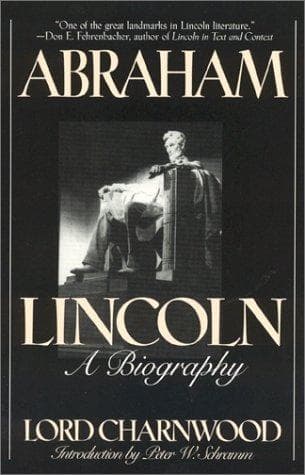
Abraham LincolnCharnwood, Godfrey Rathbone Benson, Baron
History
Abraham Lincoln
Charnwood, Godfrey Rathbone Benson, Baron
Lincoln, Abraham, 1809-1865; Presidents -- United States -- Biography
first stood up against Webster in the discussions of 1850, when Lincoln
was both silent and obscure, he had earned his position well.
Hereafter, as Lincoln's subordinate, he was to do his country
first-rate service, and to earn a pure fame as the most generously
loyal subordinate to a chief whom he had thought himself fit to
command. We happen to have ample means of estimating now all Lincoln's
Republican competitors; we know that none of the rest were equal to
Seward; and we know that Seward himself, if he had had his way, would
have brought the common cause to ruin. Looking back now at the
comparison which Lincoln, when he entered into the contest, must have
drawn between himself and Seward--for of the rest we need not take
account--we can see that to himself at least and some few in Illinois
he had now proved his capacities, and that in Seward's public record,
more especially in his attitude towards Douglas, he had the means of
measuring Seward. In spite of the far greater experience of the latter
he may have thought himself to be his superior in that indefinable
thing--the sheer strength of a man. Not only may he have thought this;
he must have known it. He had shown his grasp of the essential facts
when he forced the Republican party to do battle with Douglas and the
party of indifference; he showed the same now when, after long years of
patience and self-discipline, he pushed himself into Seward's place as
the Republican leader.
All the same, what little we know of the methods by which he now helped
his own promotion suggests that the people who then and long after set
him down as a second-rate person may have had a good deal to go upon.
A kind friend has produced a letter which he wrote in March, 1860, to a
Kansas gentleman who desired to be a delegate to the Republican
Convention, and who offered, upon condition, to persuade his fellow
delegates from Kansas to support Lincoln. Here is the letter: "As to
your kind wishes for myself, allow me to say I cannot enter the ring on
the money basis--first because in the main it is wrong; and secondly I
have not and cannot get the money. I say in the main the use of money
is wrong; but for certain objects in a political contest the use of
some is both right and indispensable. With me, as with yourself, this
long struggle has been one of great pecuniary loss. I now distinctly
say this: If you shall be appointed a delegate to Chicago I will
furnish one hundred dollars to bear the expenses of the trip." The
Kansas gentleman failed to obtain the support of the Kansas delegates
as a body for Lincoln. Lincoln none the less held to his promise of a
hundred dollars if the man came to Chicago; and, having, we are
assured, much confidence in him, took the earliest opportunity of
appointing him to a lucrative office, besides consulting him as to
other appointments in Kansas. This is all that we know of the affair,
but our informant presents it as one of a number of instances in which
Public-domain text, read in full here on John Shaqi.
Reviews
Reviews
No reviews yet
Be the first to share your thoughts on this work.
Elsewhere in the archive
Join the Discussion
Join the discussion
Sign in to leave a comment or review.
Sign InorCreate an account