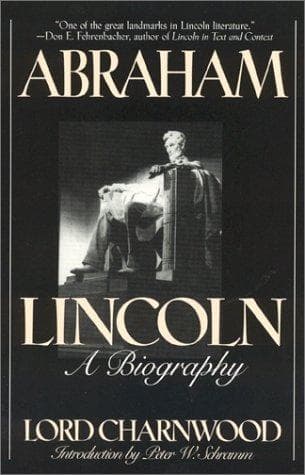
Abraham LincolnCharnwood, Godfrey Rathbone Benson, Baron
History
Abraham Lincoln
Charnwood, Godfrey Rathbone Benson, Baron
Lincoln, Abraham, 1809-1865; Presidents -- United States -- Biography
On the whole, if we can put aside the illusion which besets us, who
read the preceding history if at all in the light of Lincoln's
speeches, and to whom his competitors are mere names, this was the most
surprising nomination ever made in America. Other Presidential
candidates have been born in poverty, but none ever wore the scars of
poverty so plainly; others have been intrinsically more obscure, but
these have usually been chosen as bearing the hall-mark of eminent
prosperity or gentility. Lincoln had indeed at this time displayed
brilliant ability in the debates with Douglas, and he had really shown
a statesman's grasp of the situation more than any other Republican
leader. The friends in Illinois who put him forward--men like David
Davis, who was a man of distinction himself--did so from a true
appreciation of his powers. But this does not seem to have been the
case with the bulk of the delegates from other States. The explanation
given us of their action is curious. The choice was not the result of
merit; on the other hand, it was not the work of the ordinary wicked
wire-puller, for what may be called the machine was working for Seward.
The choice was made by plain representative Americans who set to
themselves this question: "With what candidate can we beat Douglas?"
and who found the answer in the prevalence of a popular impression,
concerning Lincoln and Seward, which was in fact wholly mistaken.
There was, it happens, earnest opposition to Seward among some Eastern
Republicans on the good ground that he was a clean man but with
doubtful associates. This opposition could not by itself have defeated
him. What did defeat him was his reputation at the moment as a very
advanced Republican who would scare away the support of the weaker
brethren. He was, for instance, the author of the alarming phrase
about "irrepressible conflict," and he had spoken once, in a phrase
that was misinterpreted, about "a higher law than the Constitution."
Lincoln had in action taken a far stronger line than Seward; he was
also the author of the phrase about the house divided against itself;
but then, besides the fact that Lincoln was well regarded just where
Douglas was most popular, Lincoln was a less noted man than Seward and
his stronger words occasioned less wide alarm. So, to please those who
liked compromise, the Convention rejected a man who would certainly
have compromised, and chose one who would give all that moderation
demanded and die before he yielded one further inch. Many Americans
have been disposed to trace in the raising up of Lincoln the hand of a
Providence protecting their country in its worst need. It would be
affectation to set their idea altogether aside; it is, at any rate, a
memorable incident in the history of a democracy, permeated with
excellent intentions but often hopelessly subject to inferior
influences, that at this critical moment the fit man was chosen on the
very ground of his supposed unfitness.
Public-domain text, read in full here on John Shaqi.
Reviews
Reviews
No reviews yet
Be the first to share your thoughts on this work.
Elsewhere in the archive
Join the Discussion
Join the discussion
Sign in to leave a comment or review.
Sign InorCreate an account