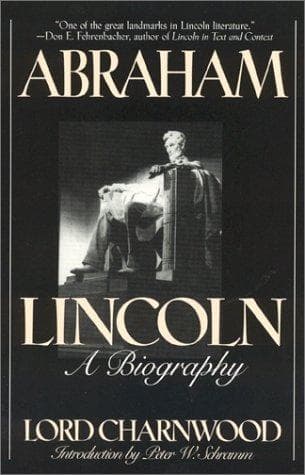
Abraham LincolnCharnwood, Godfrey Rathbone Benson, Baron
History
Abraham Lincoln
Charnwood, Godfrey Rathbone Benson, Baron
Lincoln, Abraham, 1809-1865; Presidents -- United States -- Biography
The result of the contest between the four Presidential candidates was
rendered almost a foregone conclusion by the decision of the Democrats.
Lincoln in deference to the usual and seemly procedure took no part in
the campaign, nor do his doings in the next months concern us. Seward,
to his great honour, after privately expressing his bitter chagrin at
the bestowal of what was his due upon "a little Illinois attorney,"
threw himself whole-heartedly into the contest, and went about making
admirable speeches. On the night of November 6, Lincoln sat alone with
the operator in the telegraph box at Springfield, receiving as they
came in the results of the elections of Presidential electors in the
various States. Long before the returns were complete his knowledge of
such matters made him sure of his return, and before he left that box
he had solved in principle, as he afterwards declared, the first and by
no means least important problem of his Presidency, the choice of a
Cabinet.
The victory was in one aspect far from complete. If we look not at the
votes in the Electoral College with which the formal choice of
President lay, but at the popular votes by which the electors were
returned, we shall see that the new President was elected by a minority
of the American people. He had a large majority over Douglas, but if
Douglas had received the votes which were given for the Southern
Democrat, Breckinridge, he would have had a considerable majority over
Lincoln, though the odd machinery of the Electoral College would still
have kept him out of the Presidency. In another aspect it was a
fatally significant victory. Lincoln's votes were drawn only from the
Northern States; he carried almost all the free States and he carried
no others. For the first time in American history, the united North
had used its superior numbers to outvote the South. This would in any
case have caused great vexation, and the personality of the man chosen
by the North aggravated it. The election of Lincoln was greeted
throughout the South with a howl of derision.
CHAPTER VI
SECESSION
1. _The Case of the South against the Union_.
The Republicans of the North had given their votes upon a very clear
issue, but probably few of them had fully realised how grave a result
would follow. Within a few days of the election of Lincoln the first
step in the movement of Secession had been taken, and before the new
President entered upon his duties it was plain that either the
dissatisfied States must be allowed to leave the Union or the Union must
be maintained by war.
Public-domain text, read in full here on John Shaqi.
Reviews
Reviews
No reviews yet
Be the first to share your thoughts on this work.
Elsewhere in the archive
Join the Discussion
Join the discussion
Sign in to leave a comment or review.
Sign InorCreate an account