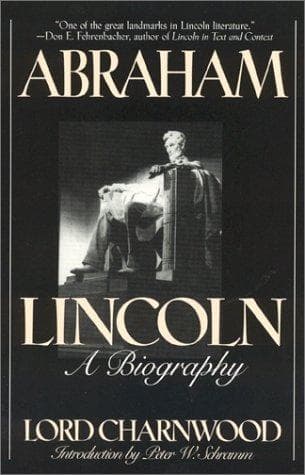
Abraham LincolnCharnwood, Godfrey Rathbone Benson, Baron
History
Abraham Lincoln
Charnwood, Godfrey Rathbone Benson, Baron
Lincoln, Abraham, 1809-1865; Presidents -- United States -- Biography
But, broadly speaking, it is certain that the movement for
secession was begun with at least as general an enthusiasm and maintained
with at least as loyal a devotion as any national movement with which it
can be compared. And yet to-day, just fifty-one years after the
consummation of its failure, it may be doubted whether one soul among the
people concerned regrets that it failed.
English people from that time to this have found the statement
incredible; but the fact is that this imposing movement, in which rich
and poor, gentle and simple, astute men of state and pious clergymen,
went hand in hand to the verge of ruin and beyond, was undertaken simply
and solely in behalf of slavery. Northern writers of the time found it
so surprising that they took refuge in the theory of conspiracy, alleging
that a handful of schemers succeeded, by the help of fictitious popular
clamour and intimidation of their opponents, in launching the South upon
a course to which the real mind of the people was averse. Later and
calmer historical survey of the facts has completely dispelled this view;
and the English suspicion, that there must have been some cause beyond
and above slavery for desiring independence, never had any facts to
support it. Since 1830 no exponent of Southern views had ever hinted at
secession on any other ground than slavery; every Southern leader
declared with undoubted truth that on every other ground he prized the
Union; outside South Carolina every Southern leader made an earnest
attempt before he surrendered the Union cause to secure the guarantees he
thought sufficient for slavery within the Union. The Southern statesman
(for the soldiers were not statesmen) whose character most attracts
sympathy now was Alexander Stephens, the Vice-President of the Southern
Confederacy, and though he was the man who persisted longest in the view
that slavery could be adequately secured without secession, he was none
the less entitled to speak for the South in his remarkable words on the
Constitution adopted by the Southern Confederacy: "The new Constitution
has put at rest for ever all the agitating questions relating to our
peculiar institution, African slavery. This was the immediate cause of
the late rupture and present revolution. The prevailing ideas
entertained by Jefferson and most of the leading statesmen at the time of
the old Constitution were that the enslavement of the African was wrong
in principle socially, morally, and politically. Our new government is
founded upon exactly the opposite idea; its foundations are laid, its
corner stone rests, upon the great truth that the negro is not the equal
of the white man; that slavery--subordination to the white man--is his
natural and normal condition. This, our new government, is the first in
the history of the world based upon this great physical, philosophical,
and moral truth. The great objects of humanity are best attained when
Public-domain text, read in full here on John Shaqi.
Reviews
Reviews
No reviews yet
Be the first to share your thoughts on this work.
Elsewhere in the archive
Join the Discussion
Join the discussion
Sign in to leave a comment or review.
Sign InorCreate an account