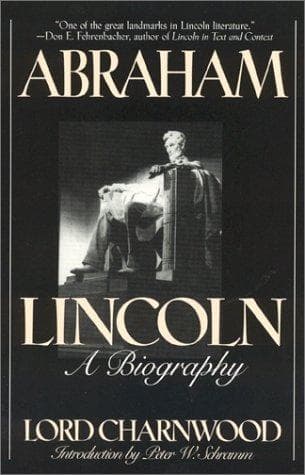
Abraham LincolnCharnwood, Godfrey Rathbone Benson, Baron
History
Abraham Lincoln
Charnwood, Godfrey Rathbone Benson, Baron
Lincoln, Abraham, 1809-1865; Presidents -- United States -- Biography
The Duke of Argyll, one of the few British statesmen of the time who
followed this struggle with intelligent interest, briefly summed up the
question thus: "I know of no government in the world that could possibly
have admitted the right of secession from its own allegiance." Oddly
enough, President Buchanan, in his Message to Congress on December 4, put
the same point not less forcibly.
But to say--as in a legal sense we may--that the Southern States rebelled
is not necessarily to say that they were wrong. The deliberate endeavour
of a people to separate themselves from the political sovereignty under
which they live and set up a new political community, in which their
national life shall develop itself more fully or more securely, must
always command a certain respect. Whether it is entitled further to the
full sympathy and to the support or at least acquiescence of others is a
question which in particular cases involves considerations such as cannot
be foreseen in any abstract discussion of political theory. But,
speaking very generally, it is a question in the main of the worth which
we attribute on the one hand to the common life to which it is sought to
give freer scope, and on the other hand to the common life which may
thereby be weakened or broken up. It sometimes seems to be held that
when a decided majority of the people whose voices can be heard, in a
more or less defined area, elect to live for the future under a
particular government, all enlightened men elsewhere would wish them to
have their way. If any such principle could be accepted without
qualification, few movements for independence would ever have been more
completely justified than the secession of the Southern States. If we
set aside the highland region of which mention has already been made, in
the six cotton-growing States which first seceded, and in several of
those which followed as soon as it was clear that secession would be
resisted, the preponderance of opinion in favour of the movement was
overwhelming. This was not only so among the educated and governing
portions of society, which were interested in slavery. While the negroes
themselves were unorganised and dumb and made no stir for freedom, the
poorer class of white people, to whom the institution of slavery was in
reality oppressive, were quite unconscious of this; the enslavement of
the negro appeared to them a tribute to their own dignity, and their
indiscriminating spirit of independence responded enthusiastically to the
appeal that they should assert themselves against the real or fancied
pretensions of the North. So large a statement would require some
qualification if we were here concerned with the life of a Southern
leader; and there was of course a brief space, to be dealt with in this
chapter, in which the question of secession hung in the balance, and it
is true in this, as in every case, that the men who gave the initial push
were few.
Public-domain text, read in full here on John Shaqi.
Reviews
Reviews
No reviews yet
Be the first to share your thoughts on this work.
Elsewhere in the archive
Join the Discussion
Join the discussion
Sign in to leave a comment or review.
Sign InorCreate an account