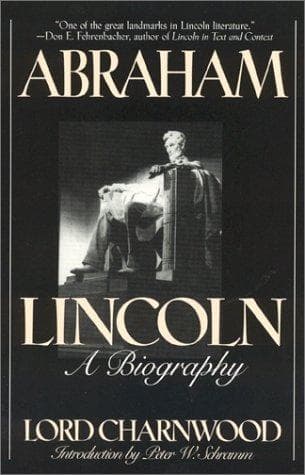
Abraham LincolnCharnwood, Godfrey Rathbone Benson, Baron
History
Abraham Lincoln
Charnwood, Godfrey Rathbone Benson, Baron
Lincoln, Abraham, 1809-1865; Presidents -- United States -- Biography
And it must never be forgotten, if we wish to enter into the spirit which
sustained the North in its struggle, that loyalty for Union had a larger
aspect than that of mere allegiance to a particular authority. Vividly
present to the mind of some few, vaguely but honestly present to the mind
of a great multitude, was the sense that even had slavery not entered
into the question a larger cause than that of their recent Union was
bound up with the issues of the war. The Government of the United States
had been the first and most famous attempt in a great modern country to
secure government by the will of the mass of the people. If in this
crucial instance such a Government were seen to be intolerably weak, if
it was found to be at the mercy of the first powerful minority which
seized a worked-up occasion to rebel, what they had learnt to think the
most hopeful agency for the uplifting of man everywhere would for ages to
come have proved a failure. This feeling could not be stronger in any
American than it was in Lincoln himself. "It has long been a question,"
he said, "whether any Government which is not too strong for the
liberties of the people can be strong enough to maintain itself." There
is one marked feature of his patriotism, which could be illustrated by
abundance of phrases from his speeches and letters, and which the people
of several countries of Europe can appreciate to-day. His affection for
his own country and its institutions is curiously dependent upon a wider
cause of human good, and is not a whit the less intense for that. There
is perhaps no better expression of this widespread feeling in the North
than the unprepared speech which he delivered on his way to become
President, in the Hall of Independence at Philadelphia, in which the
Declaration of Independence had been signed. "I have never," he said,
"had a feeling politically that did not spring from the sentiments
embodied in the Declaration of Independence. I have often pondered over
the dangers which were incurred by the men who assembled here and framed
and adopted that Declaration of Independence. I have pondered over the
toils that were endured by the officers and soldiers of the army who
achieved that independence. I have often inquired of myself what great
principle or idea it was that kept the Confederacy so long together. It
was not the mere matter of separation of the colonies from the
motherland, it was the sentiment in the Declaration of Independence which
gave liberty, not alone to the people of this country, but I hope to the
world, for all future time. It was that which gave promise that in due
time the weight would be lifted from the shoulders of all men."
2. _The Progress of Secession_.
Public-domain text, read in full here on John Shaqi.
Reviews
Reviews
No reviews yet
Be the first to share your thoughts on this work.
Elsewhere in the archive
Join the Discussion
Join the discussion
Sign in to leave a comment or review.
Sign InorCreate an account