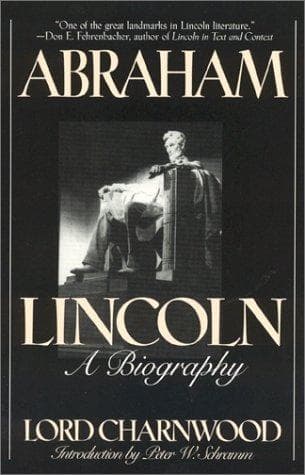
Abraham LincolnCharnwood, Godfrey Rathbone Benson, Baron
History
Abraham Lincoln
Charnwood, Godfrey Rathbone Benson, Baron
Lincoln, Abraham, 1809-1865; Presidents -- United States -- Biography
The South was neither base nor senseless, but it was wrong. To some
minds it may not seem to follow that it was well to resist it by war, and
indeed at the time, as often happens, people took up arms with greater
searchings of heart upon the right side than upon the wrong. If the
slave States had been suffered to depart in peace they would have set up
a new and peculiar political society, more truly held together than the
original Union by a single avowed principle; a nation dedicated to the
inequality of men. It is not really possible to think of the free
national life which they could thus have initiated as a thing to be
respected and preserved. Nor is it true that their choice for themselves
of this dingy freedom was no concern of their neighbours. We have seen
how the slave interest hankered for enlarged dominion; and it is certain
that the Southern Confederacy, once firmly established, would have been
an aggressive and disturbing power upon the continent of America. The
questions of territorial and other rights between it and the old Union
might have been capable of satisfactory settlement for the moment, or
they might have proved as insoluble as Lincoln thought they were. But,
at the best, if the States which adhered to the old Union had admitted
the claim of the first seceding States to go, they could only have
retained for themselves an insecure existence as a nation, threatened at
each fresh conflict of interest or sentiment with a further disruption
which could not upon any principle have been resisted. The preceding
chapters have dwelt with iteration upon the sentiments which had operated
to make Americans a people, and on the form and the degree in which those
sentiments animated the mind of Lincoln. Only so perhaps can we fully
appreciate for what the people of the North fought. It is inaccurate,
though not gravely misleading, to say that they fought against slavery.
It would be wholly false to say that they fought for mere dominion. They
fought to preserve and complete a political unity nobly conceived by
those who had done most to create it, and capable, as the sequel showed,
of a permanent and a healthy continuance.
Public-domain text, read in full here on John Shaqi.
Reviews
Reviews
No reviews yet
Be the first to share your thoughts on this work.
Elsewhere in the archive
Join the Discussion
Join the discussion
Sign in to leave a comment or review.
Sign InorCreate an account