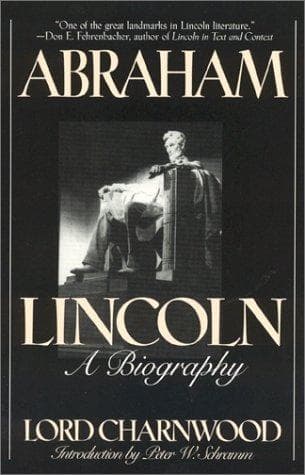
Abraham LincolnCharnwood, Godfrey Rathbone Benson, Baron
History
Abraham Lincoln
Charnwood, Godfrey Rathbone Benson, Baron
Lincoln, Abraham, 1809-1865; Presidents -- United States -- Biography
saved much bloodshed, but he would not have left the United States a
country of which any good man was proud to be a citizen.
Thus, by the end of 1860, the bottom was really out of the policy of
compromise, and it is not worth while to examine the praiseworthy efforts
that were still made for it while State after State in the South was
deciding to secede. One interesting proposal, which was aired in
January, 1861, deserves notice, namely, that the terms of compromise
proposed by Crittenden should have been submitted to a vote of the whole
people. It was not passed. Seward, whom many people now thought likely
to catch at any and every proposal for a settlement, said afterwards with
justice that it was "unconstitutional and ineffectual." Ineffectual it
would have been in this sense: the compromise would in all probability
have been carried by a majority consisting of men in the border States
and of all those elsewhere who, though they feared war and desired good
feeling, had no further definite opinion upon the chief questions at
issue; but it would have left a local majority in many of the Southern
States and a local majority in many of the Northern States as
irreconcilable with each other as ever. It was opposed also to the
spirit of the Constitution. In a great country where the people with
infinitely varied interests and opinions can slowly make their
predominant wishes appear, but cannot really take counsel together and
give a firm decision upon any emergency, there may be exceptional cases
when a popular vote on a defined issue would be valuable, significant,
desired by the people themselves; but the machinery of representative
government, however faulty, is the only machinery by which the people can
in some sense govern itself, instead of making itself ungovernable.
Above all, in a serious crisis it is supremely repugnant to the spirit of
popular government that the men chosen by a people to govern it should
throw their responsibility back at the heads of the electors. It is well
to be clear as to the kind of proceeding which the authors of this
proposal were really advocating: a statesman has come before the ordinary
citizen with a definite statement of the principle on which he would act,
and an ordinary citizen has thereupon taken his part in entrusting him
with power; then comes the moment for the statesman to carry out his
principle, and the latent opposition becomes of necessity more alarming;
the statesman is therefore to say to the ordinary citizen, "This is a
more difficult matter than I thought; and if I am to act as I said I
would, take on yourself the responsibility which I recently put myself
forward to bear." The ordinary citizen will naturally as a rule decline
a responsibility thus offered him, but he will not be grateful for the
offer or glad to be a forced accomplice in this process of indecision.
Public-domain text, read in full here on John Shaqi.
Reviews
Reviews
No reviews yet
Be the first to share your thoughts on this work.
Elsewhere in the archive
Join the Discussion
Join the discussion
Sign in to leave a comment or review.
Sign InorCreate an account