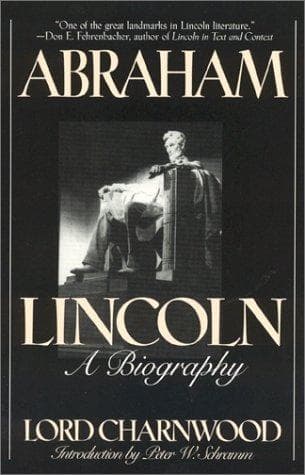
Abraham LincolnCharnwood, Godfrey Rathbone Benson, Baron
History
Abraham Lincoln
Charnwood, Godfrey Rathbone Benson, Baron
Lincoln, Abraham, 1809-1865; Presidents -- United States -- Biography
Thus Lincoln was very far from inspiring general confidence in anything
beyond his good intentions. He is remembered as a personality with a
"something" about him--the vague phrase is John Bright's--which widely
endeared him, but his was by no means that "magnetic" personality which
we might be led to believe was indispensable in America. Indeed, it is
remarkable that to some really good judges he remained always
unimpressive. Charles Francis Adams, who during the Civil War served
his country as well as Minister in London as his grandfather had done
after the War of Independence, lamented to the end that Seward, his
immediate chief, had to serve under an inferior man; and a more
sympathetic man, Lord Lyons, our representative at Washington, refers
to Lincoln with nothing more than an amused kindliness. No detail of
his policy has escaped fierce criticism, and the man himself while he
lived was the subject of so much depreciation and condescending
approval, that we are forced to ask who discovered his greatness till
his death inclined them to idealise him. The answer is that precisely
those Americans of trained intellect whose title to this description is
clearest outside America were the first who began to see beneath his
strange exterior. Lowell, watching the course of public events with
ceaseless scrutiny; Walt Whitman, sauntering in Washington in the
intervals of the labour among the wounded by which he broke down his
robust strength, and seeing things as they passed with the sure
observation of a poet; Motley, the historian of the Dutch Republic,
studying affairs in the thick of them at the outset of the war, and not
less closely by correspondence when he went as Minister to Vienna--such
men when they praised Lincoln after his death expressed a judgment
which they began to form from the first; a judgment which started with
the recognition of his honesty, traced the evidence of his wisdom as it
appeared, gradually and not by repentant impulse learned his greatness.
And it is a judgment large enough to explain the lower estimate of
Lincoln which certainly had wide currency. Not to multiply witnesses,
Motley in June, 1861, having seen him for the second time, writes: "I
went and had an hour's talk with Mr. Lincoln. I am very glad of it,
for, had I not done so, I should have left Washington with a very
inaccurate impression of the President. I am now satisfied that he is
a man of very considerable native sagacity; and that he has an
ingenuous, unsophisticated, frank, and noble character. I believe him
to be as true as steel, and as courageous as true. At the same time
there is doubtless an ignorance about State matters, and particularly
about foreign affairs, which he does not attempt to conceal, but which
we must of necessity regret in a man placed in such a position at such
a crisis. Nevertheless his very modesty in this respect disarms
criticism. We parted very affectionately, and perhaps I shall never
Public-domain text, read in full here on John Shaqi.
Reviews
Reviews
No reviews yet
Be the first to share your thoughts on this work.
Elsewhere in the archive
Join the Discussion
Join the discussion
Sign in to leave a comment or review.
Sign InorCreate an account