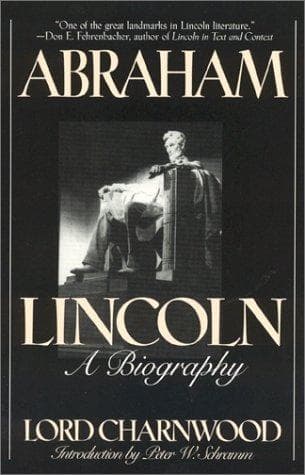
Abraham LincolnCharnwood, Godfrey Rathbone Benson, Baron
History
Abraham Lincoln
Charnwood, Godfrey Rathbone Benson, Baron
Lincoln, Abraham, 1809-1865; Presidents -- United States -- Biography
set eyes on him again, but I feel that, so far as perfect integrity and
directness of purpose go, the country will be safe in his hands."
Three years had passed, and the political world of America was in that
storm of general dissatisfaction in which not a member of Congress
would be known as "a Lincoln man," when Motley writes again from Vienna
to his mother, "I venerate Abraham Lincoln exactly because he is the
true, honest type of American democracy. There is nothing of the
shabby-genteel, the would-be-but-couldn't-be fine gentleman; he is the
great American Demos, honest, shrewd, homely, wise, humorous, cheerful,
brave, blundering occasionally, but through blunders struggling onwards
towards what he believes the right." In a later letter he observes,
"His mental abilities were large, and they became the more robust as
the more weight was imposed upon them."
This last sentence, especially if in Lincoln's mental abilities the
qualities of his character be included, probably indicates the chief
point for remark in any estimate of his presidency. It is true that he
was judged at first as a stranger among strangers. Walt Whitman has
described vividly a scene, with "a dash of comedy, almost farce, such
as Shakespeare puts in his blackest tragedies," outside the hotel in
New York where Lincoln stayed on his journey to Washington; "his look
and gait, his perfect composure and coolness," to cut it short, the
usually noted marks of his eccentricity, "as he stood looking with
curiosity on that immense sea of faces, and the sea of faces returned
the look with similar curiosity, not a single one" among the crowd "his
personal friend." He was not much otherwise situated when he came to
Washington. It is true also that in the early days he was learning his
business. "Why, Mr. President," said some one towards the end of his
life, "you have changed your mind." "Yes, I have," said he, "and I
don't think much of a man who isn't wiser to-day than he was
yesterday." But it seems to be above all true that the exercise of
power and the endurance of responsibility gave him new strength. This,
of course, cannot be demonstrated, but Americans then living, who
recall Abraham Lincoln, remark most frequently how the man grew to his
task. And this perhaps is the main impression which the slight record
here presented will convey, the impression of a man quite unlike the
many statesmen whom power and the vexations attendant upon it have in
some piteous way spoiled and marred, a man who started by being tough
and shrewd and canny and became very strong and very wise, started with
an inclination to honesty, courage, and kindness, and became, under a
tremendous strain, honest, brave, and kind to an almost tremendous
degree.
Public-domain text, read in full here on John Shaqi.
Reviews
Reviews
No reviews yet
Be the first to share your thoughts on this work.
Elsewhere in the archive
Join the Discussion
Join the discussion
Sign in to leave a comment or review.
Sign InorCreate an account