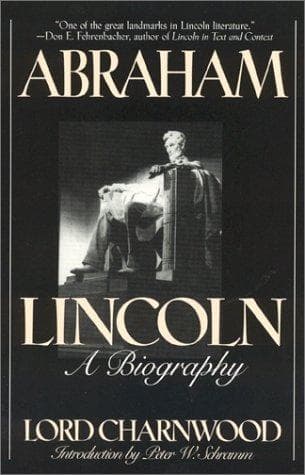
Abraham LincolnCharnwood, Godfrey Rathbone Benson, Baron
History
Abraham Lincoln
Charnwood, Godfrey Rathbone Benson, Baron
Lincoln, Abraham, 1809-1865; Presidents -- United States -- Biography
The fall of Washington at that moment would have had political
consequences which no one realised better than Lincoln. It might well
have led the Unionists in the border States to despair, and there is
evidence that even then he so fully realised the task which lay before
the North as to feel that the loss of Maryland, Kentucky, and Missouri
would have made it impossible. He was at heart intensely anxious, and
quaintly and injudiciously relieved his feelings by the remark to the
"6th Massachusetts" that he felt as if all other help were a dream, and
they were "the only real thing." Yet those who were with him testify
to his composure and to the vigour with which he concerted with his
Cabinet the various measures of naval, military, financial, postal, and
police preparation which the occasion required, but which need not here
be detailed. Many of the measures of course lay outside the powers
which Congress had conferred on the public departments, but the
President had no hesitation in "availing himself," as he put it, "of
the broader powers conferred by the Constitution in cases of
insurrection," and looking for the sanction of Congress afterwards,
rather than "let the Government at once fall into ruin." The
difficulties of government were greatly aggravated by the uncertainty
as to which of its servants, civil, naval, or military, were loyal, and
the need of rapidly filling the many posts left vacant by unexpected
desertion. Meanwhile troops from New England, and also from New York,
which had utterly disappointed some natural expectations in the South
by the enthusiasm of its rally to the Union, quickly arrived near
Baltimore. They repaired for themselves the interrupted railway tracks
round the city, and by April 25 enough soldiers were in Washington to
put an end to any present alarm. In case of need, the law of "habeas
corpus" was suspended in Maryland. The President had no wish that
unnecessary recourse should be had to martial law. Naturally, however,
one of his generals summarily arrested a Southern recruiting agent in
Baltimore. The ordinary law would probably have sufficed, and Lincoln
is believed to have regretted this action, but it was obvious that he
must support it when done. Hence arose an occasion for the old Chief
Justice Taney to make a protest on behalf of legality, to which the
President, who had armed force on his side, could not give way, and
thus early began a controversy to which we must recur. It was gravely
urged upon Lincoln that he should forcibly prevent the Legislature of
Maryland from holding a formal sitting; he refused on the sensible
ground that the legislators could assemble in some way and had better
not assemble with a real grievance in constitutional law. Then a
strange alteration came over Baltimore. Within three weeks all active
demonstration in favour of the South had subsided; the disaffected
Legislature resolved upon neutrality; the Governor, loyal at heart--if
Public-domain text, read in full here on John Shaqi.
Reviews
Reviews
No reviews yet
Be the first to share your thoughts on this work.
Elsewhere in the archive
Join the Discussion
Join the discussion
Sign in to leave a comment or review.
Sign InorCreate an account