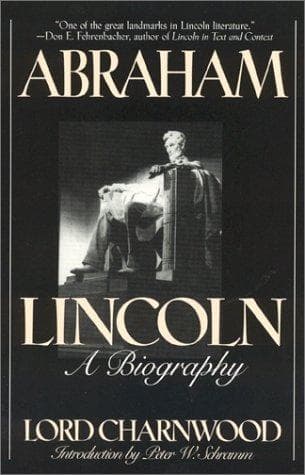
Abraham LincolnCharnwood, Godfrey Rathbone Benson, Baron
History
Abraham Lincoln
Charnwood, Godfrey Rathbone Benson, Baron
Lincoln, Abraham, 1809-1865; Presidents -- United States -- Biography
The North then started upon the struggle with an eagerness and
unanimity from which the revulsion was to try all hearts, and the
President's most of all; and not a man in the North guessed what the
strain of that struggle was to be. At first indeed there was alarm in
Washington for the immediate safety of the city. Confederate flags
could be seen floating from the hotels in Alexandria across the river;
Washington itself was full of rumours of plots and intended
assassinations, and full of actual Southern spies; everything was
disorganised; and Lincoln himself, walking round one night, found the
arsenal with open doors, absolutely unguarded.
By April 20, first the Navy Yard at Gosport, in Virginia, had to be
abandoned, then the Arsenal at Harper's Ferry, and on the day of this
latter event Lee went over to the South. One regiment from
Massachusetts, where the State authorities had prepared for war before
the fall of Sumter, was already in Washington; but it had had to fight
its way through a furious mob in Baltimore, with some loss of life on
both sides. A deputation from many churches in that city came to the
President, begging him to desist from his bloodthirsty preparations,
but found him "constitutionally genial and jovial," and "wholly
inaccessible to Christian appeals." It mattered more that a majority
of the Maryland Legislature was for the South, and that the Governor
temporised and requested that no more troops should pass through
Baltimore. The Mayor of Baltimore and the railway authorities burned
railway bridges and tore up railway lines, and the telegraph wires were
cut. Thus for about five days the direct route to Washington from the
North was barred. It seemed as if the boast of some Southern orator
that the Confederate flag would float over the capital by May 1 might
be fulfilled. Beauregard could have transported his now drilled troops
by rail from South Carolina and would have found Washington isolated
and hardly garrisoned. As a matter of fact, no such daring move was
contemplated in the South, and the citizens of Richmond, Virginia, were
themselves under a similar alarm; but the South had a real opportunity.
Public-domain text, read in full here on John Shaqi.
Reviews
Reviews
No reviews yet
Be the first to share your thoughts on this work.
Elsewhere in the archive
Join the Discussion
Join the discussion
Sign in to leave a comment or review.
Sign InorCreate an account