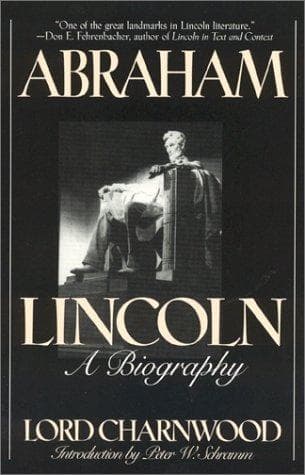
Abraham LincolnCharnwood, Godfrey Rathbone Benson, Baron
History
Abraham Lincoln
Charnwood, Godfrey Rathbone Benson, Baron
Lincoln, Abraham, 1809-1865; Presidents -- United States -- Biography
but that Sherman unlawfully threatened to shoot him if he did so.
Lincoln had a good look at Sherman, and then advised the colonel to
keep out of Sherman's way, as he looked like a man of his word. This
was said in the hearing of many men, and Sherman records his lively
gratitude for a simple jest which helped him greatly in keeping his
brigade in existence.
Not one of the much more serious defeats suffered later in the war
produced by itself so lively a sense of discomfiture in the North as
this; thus none will equally claim our attention. But, except for the
first false alarms in Washington, there was no disposition to mistake
its military significance. The "second uprising of the North," which
followed upon this bracing shock, left as vivid a memory as the little
disaster of Bull Run. But there was of necessity a long pause while
McClellan remodelled the army in the East, and the situation in the
West was becoming ripe for important movements. The eagerness of the
Northern people to make some progress, again asserted itself before
long, but to their surprise, and perhaps to that of a reader to-day,
the last five months of 1861 passed without notable military events.
Here then we may turn to the progress of other affairs, departmental
affairs, foreign affairs, and domestic policy, which, it must not be
forgotten, had pressed heavily upon the Administration from the moment
that war began.
3. _Lincoln's Administration Generally_.
Long before the Eastern public was very keenly aware of Lincoln the
members of his Cabinet had come to think of the Administration as his
Administration, some, like Seward, of whom it could have been little
expected, with a loyal, and for America most fortunate, acceptance of
real subordination, and one at least, Chase, with indignant surprise
that his own really great abilities were not dominant. One Minister
early told his friends that there was but one vote in the Cabinet, the
President's. This must not be taken in the sense that Lincoln's
personal guidance was present in every department. He had his own
department, concerned with the maintenance of Northern unity and with
that great underlying problem of internal policy which will before long
appear again, and the business of the War Department was so immediately
vital as to require his ceaseless attention; but in other matters the
degree and manner of his control of course varied. Again, it is far
from being the case that the Cabinet had little influence on his
action. He not only consulted it much, but deferred to it much. His
wisdom seems to have shown itself in nothing more strongly than in
recognising when he wanted advice and when he did not, when he needed
support and when he could stand alone. Sometimes he yielded to his
Ministers because he valued their judgment, sometimes also because he
gauged by them the public support without which his action must fail.
Sometimes, when he was sure of the necessity, he took grave steps
Public-domain text, read in full here on John Shaqi.
Reviews
Reviews
No reviews yet
Be the first to share your thoughts on this work.
Elsewhere in the archive
Join the Discussion
Join the discussion
Sign in to leave a comment or review.
Sign InorCreate an account