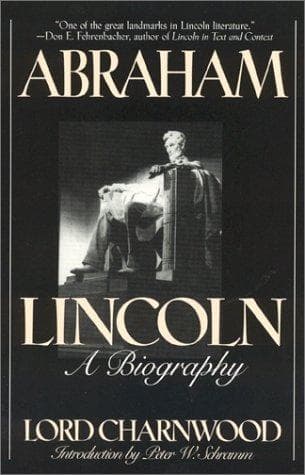
Abraham LincolnCharnwood, Godfrey Rathbone Benson, Baron
History
Abraham Lincoln
Charnwood, Godfrey Rathbone Benson, Baron
Lincoln, Abraham, 1809-1865; Presidents -- United States -- Biography
really hopeless, but some declare that the Northern soldiers with one
accord became possessed of a belief that this flank attack by a
comparatively small body was that of the whole force of Johnston,
freshly arrived upon the scene. In any case they spontaneously retired
in disorder; they were not effectively pursued, but McDowell was unable
to rally them at Centreville, a mile or so behind the Bull Run. Among
the camp followers the panic became extreme, and they pressed into
Washington in wild alarm, accompanied by citizens and Congressmen who
had come out to see a victory, and who left one or two of their number
behind as prisoners of war. The result was a surprise to the Southern
army. Johnston, who now took over the command, declared that it was as
much disorganised by victory as the Northern army by defeat. With the
full approval of his superiors in Richmond, he devoted himself to
entrenching his position at Manassas. But in Washington, where rumours
of victory had been arriving all through the day of battle, there
prevailed for some time an impression that the city was exposed to
immediate capture, and this impression was shared by McClellan, to whom
universal opinion now turned as the appointed saviour, and who was
forthwith summoned to Washington to take command of the army of the
Potomac.
Within the circle of the Administration there was, of course, deep
mortification. Old General Scott passionately declared himself to have
been the greatest coward in America in having ever given way to the
President's desire for action. Lincoln, who was often to prove his
readiness to take blame on his own shoulders, evidently thought that
the responsibility in this case was shared by Scott, and demanded to
know whether Scott accused him of having overborne his judgment. The
old general warmly, if a little ambiguously, replied that he had served
under many Presidents, but never known a kinder master. Plainly he
felt that his better judgment had somehow been overpowered, and yet
that there was nothing in their relations for which in his heart he
could blame the President; and this trivial dialogue is worth
remembering during the dreary and controversial tale of Lincoln's
relations with Scott's successor. Lincoln, however bitterly
disappointed, showed no signs of discomposure or hesitancy. The
business of making the army of the Potomac quietly began over again.
To the four days after Bull Run belongs one of the few records of the
visits to the troops which Lincoln constantly paid when they were not
too far from Washington, cheering them with little talks which served a
good purpose without being notable. He was reviewing the brigade
commanded at Bull Run by William Sherman, later, but not yet, one of
the great figures in the war. He was open to all complaints, and a
colonel of militia came to him with a grievance; he claimed that his
term of service had already expired, that he had intended to go home,
Public-domain text, read in full here on John Shaqi.
Reviews
Reviews
No reviews yet
Be the first to share your thoughts on this work.
Elsewhere in the archive
Join the Discussion
Join the discussion
Sign in to leave a comment or review.
Sign InorCreate an account