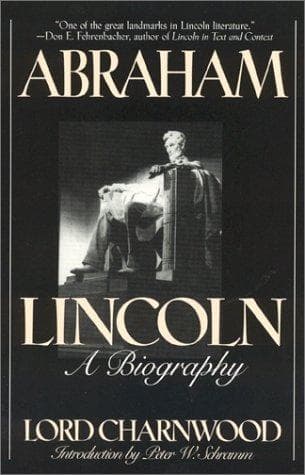
Abraham LincolnCharnwood, Godfrey Rathbone Benson, Baron
History
Abraham Lincoln
Charnwood, Godfrey Rathbone Benson, Baron
Lincoln, Abraham, 1809-1865; Presidents -- United States -- Biography
Here came in the one clearly known and most certainly happy
intervention of Lincoln's in foreign affairs. Early in May Seward
brought to him the draft of a vehement despatch, telling the British
Government peremptorily what the United States would not stand, and
framed in a manner which must have frustrated any attempt by Adams in
London to establish good relations with Lord John Russell. That draft
now exists with the alterations made in Lincoln's own hand. With a few
touches, some of them very minute, made with the skill of a master of
language and of a life-long peacemaker, he changed the draft into a
firm but entirely courteous despatch. In particular, instead of
requiring Adams, as Seward would have done, to read the whole despatch
to Russell and leave him with a copy of it, he left it to the man on
the spot to convey its sense in what manner he judged best. Probably,
as has been claimed for him, his few penstrokes made peaceful relations
easy when Seward's despatch would have made them almost impossible;
certainly a study of this document will prove both his strange,
untutored diplomatic skill and the general soundness of his view of
foreign affairs.
Now, however, followed a graver crisis in which his action requires
some discussion. Messrs. Mason and Slidell were sent by the
Confederate Government as their emissaries to England and France. They
got to Havana and there took ship again on the British steamer _Trent_.
A watchful Northern sea captain overhauled the _Trent_, took Mason and
Slidell off her, and let her go. If he had taken the course, far more
inconvenient to the _Trent_, of bringing her into a Northern harbour,
where a Northern Prize Court might have adjudged these gentlemen to be
bearers of enemy despatches, he would have been within the law. As it
was he violated well-established usage, and no one has questioned the
right and even the duty of the British Government to demand the release
of the prisoners. This they did in a note of which the expression was
made milder by the wish of the Queen (conveyed in almost the last
letter of the Prince Consort), but which required compliance within a
fortnight. Meanwhile Secretary Welles had approved the sea captain's
action. The North was jubilant at the capture, the more so because
Mason and Slidell were Southern statesmen of the lower type and held to
be specially obnoxious; and the House of Representatives, to make
matters worse, voted its approval of what had been done. Lincoln, on
the very day when the news of the capture came, had seen and said
privately that on the principles which America had itself upheld in the
past the prisoners would have to be given up with an apology. But
there is evidence that he now wavered, and that, bent as he was on
maintaining a united North, he was still too distrustful of his own
better judgment as against that of the public. At this very time he
was already on other points in painful conflict with many friends. In
Public-domain text, read in full here on John Shaqi.
Reviews
Reviews
No reviews yet
Be the first to share your thoughts on this work.
Elsewhere in the archive
Join the Discussion
Join the discussion
Sign in to leave a comment or review.
Sign InorCreate an account