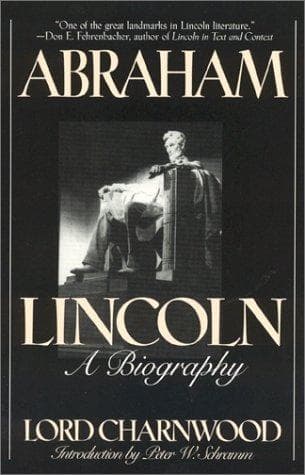
Abraham LincolnCharnwood, Godfrey Rathbone Benson, Baron
History
Abraham Lincoln
Charnwood, Godfrey Rathbone Benson, Baron
Lincoln, Abraham, 1809-1865; Presidents -- United States -- Biography
any case he submitted to Seward a draft despatch making the ill-judged
proposal of arbitration. He gave way to Seward, but at the Cabinet
meeting on Christmas Eve, at which Seward submitted a despatch yielding
to the British demand, it is reported that Lincoln, as well as Chase
and others, was at first reluctant to agree, and that it was Bates and
Seward that persuaded the Cabinet to a just and necessary surrender.
This was the last time that there was serious friction in the actual
intercourse of the two Governments. The lapse of Great Britain in
allowing the famous _Alabama_ to sail was due to delay and misadventure
("week-ends" or the like) in the proceedings of subordinate officials,
and was never defended, and the numerous minor controversies that
arose, as well as the standing disagreement as to the law of blockade
never reached the point of danger. For all this great credit was due
to Lord Lyons and to C. F. Adams, and to Seward also, when he had a
little sobered down, but it might seem as if the credit commonly given
to Lincoln by Americans rested on little but the single happy
performance with the earlier despatch which has been mentioned. Adams
and Lyons were not aware of his beneficent influence--the papers of the
latter contain little reference to him beyond a kindly record of a
trivial conversation, at the end of which, as the Ambassador was going
for a holiday to England, the President said, "Tell the English people
I mean them no harm." Yet it is evident that Lincoln's supporters in
America, the writer of the Biglow Papers, for instance, ascribed to him
a wise, restraining power in the _Trent_ dispute. What is more,
Lincoln later claimed this for himself. Two or three years later, in
one of the confidences with which he often startled men who were but
slight acquaintances, but who generally turned out worthy of
confidence, he exclaimed with emphatic self-satisfaction, "Seward knows
that I am his master," and recalled with satisfaction how he had forced
Seward to yield to England in the _Trent_ affair. It would have been
entirely unlike him to claim praise when it was wholly undue to him; we
find him, for example, writing to Fox, of the Navy Department, about "a
blunder which was probably in part mine, and certainly was not yours";
so that a puzzling question arises here. It is quite possible that
Lincoln, who did not press his proposal of arbitration, really
manoeuvred Seward and the Cabinet into full acceptance of the British
demands by making them see the consequences of any other action. It is
also, however, likely enough that, being, as he was, interested in
arbitration generally, he was too inexperienced to see the
inappropriateness of the proposal in this case. If so, we may none the
less credit him with having forced Seward to work for peace and
friendly relations with Great Britain, and made that minister the
agent, more skilful than himself, of a peaceful resolution which in its
origin was his own.
Public-domain text, read in full here on John Shaqi.
Reviews
Reviews
No reviews yet
Be the first to share your thoughts on this work.
Elsewhere in the archive
Join the Discussion
Join the discussion
Sign in to leave a comment or review.
Sign InorCreate an account