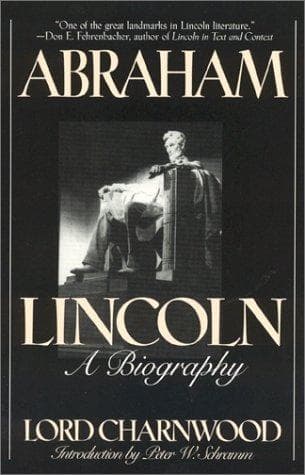
Abraham LincolnCharnwood, Godfrey Rathbone Benson, Baron
History
Abraham Lincoln
Charnwood, Godfrey Rathbone Benson, Baron
Lincoln, Abraham, 1809-1865; Presidents -- United States -- Biography
Such at first was the position taken up by an unanimous Congress. It
was obviously in accord with those political principles of Lincoln
which have been examined in a former chapter. More than that, it was
the position which, as he thought, his official duty as President
imposed on him. It is exceedingly difficult for any Englishman to
follow his course as the political situation developed. He was neither
a dictator, nor an English Prime Minister. He was first and foremost
an elected officer with powers and duties prescribed by a fixed
Constitution which he had sworn to obey. His oath was continually
present to his mind.
He was there to uphold the Union and the laws, with just so much
infraction of the letter of the law, and no more, as might be obviously
necessary if the Union and the whole fabric of law were not to perish.
The mere duration of the war altered of necessity the policy of the
North and of the President. Their task had presented itself as in
theory the "suppression of an unlawful combination" within their
country; it became in manifest fact the reabsorption of a country now
hostile, with which reunion was possible only if slavery, the
fundamental cause of difference, was uprooted.
As the hope of a speedy victory and an easy settlement vanished, wide
differences of opinion appeared again in the North, and the lines on
which this cleavage proceeded very soon showed themselves. There were
those who gladly welcomed the idea of a crusade against slavery, and
among them was an unreasonable section of so-called Radicals. These
resented that delay in a policy of wholesale liberation which was
enforced by legal and constitutional scruples, and by such practical
considerations as the situation in the slave States which adhered to
the North. There was, on the other hand, a Democratic party Opposition
which before long began to revive. It combined many shades of opinion.
There were supporters or actual agents of the South, few at first and
very quiet, but ultimately developing a treasonable activity. There
were those who constituted themselves the guardians of legality and
jealously criticised all the measures of emergency which became more or
less necessary. Of the bulk of the Democrats it would probably be fair
to say that their conscious intention throughout was to be true to the
Union, but that throughout they were beset by a respect for Southern
rights which would have gone far to paralyse the arm of the Government.
Lastly, there were Republicans, by no means in sympathy with the
Democratic view, who became suspect to their Radical fellows and were
vaguely classed together as Conservatives. This term may be taken to
cover men simply of moderate and cautious, or in some cases, of
variable disposition, but it included, too, some men who, while
rigorous against the South, were half-hearted in their detestation of
slavery.
Public-domain text, read in full here on John Shaqi.
Reviews
Reviews
No reviews yet
Be the first to share your thoughts on this work.
Elsewhere in the archive
Join the Discussion
Join the discussion
Sign in to leave a comment or review.
Sign InorCreate an account