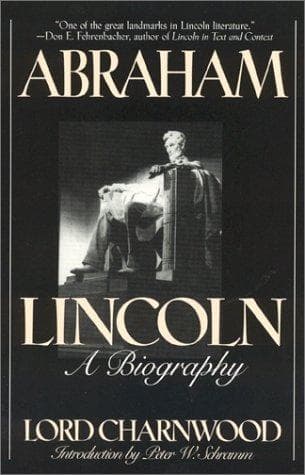
Abraham LincolnCharnwood, Godfrey Rathbone Benson, Baron
History
Abraham Lincoln
Charnwood, Godfrey Rathbone Benson, Baron
Lincoln, Abraham, 1809-1865; Presidents -- United States -- Biography
5. _The Great Questions of Domestic Policy_.
The larger questions of civil policy which arose out of the fact of the
war, and which weighed heavily on Lincoln before the end of 1861, can
be related with less intricate detail if the fundamental point of
difficulty is made clear.
Upon July 4 Congress met. In an able Message which was a skilful but
simple appeal not only to Congress, but to the "plain people," the
President set forth the nature of the struggle as he conceived it,
putting perhaps in its most powerful form the contention that the Union
was indissoluble, and declaring that the "experiment" of "our popular
government" would have failed once for all if it did not prove that
"when ballots have fairly and constitutionally decided, there can be no
successful appeal back to bullets." He recounted the steps which he
had taken since the bombardment of Fort Sumter, some of which might be
held to exceed his constitutional authority as indeed they did, saying
he would have been false to his trust if for fear of such illegality he
had let the whole Constitution perish, and asking that, if necessary,
Congress should ratify them. He appealed to Congress now to do its
part, and especially he appealed for such prompt and adequate provision
of money and men as would enable the war to be speedily brought to a
close. Congress, with but a few dissentient voices, chiefly from the
border States, approved all that he had done, and voted the supplies
that he had asked. Then, by a resolution of both Houses, it defined
the object of the war; the war was not for any purpose of conquest or
subjugation, or of "overthrowing or interfering with the rights or
established institutions" of the Southern States; it was solely "to
preserve the Union with all the dignity, equality, and rights of the
several States unimpaired."
In this resolution may be found the clue to the supreme political
problem with which, side by side with the conduct of the war, Lincoln
was called upon to grapple unceasingly for the rest of his life. That
problem lay in the inevitable change, as the war dragged on, of the
political object involved in it. The North as yet was not making war
upon the institutions of Southern States, in other words upon slavery,
and it would have been wrong to do so. It was simply asserting the
supremacy of law by putting down what every man in the North regarded
as rebellion. That rebellion, it seemed likely, would completely
subside after a decisive defeat or two of the Southern forces. The law
and the Union would then have been restored as before. A great victory
would in fact have been won over slavery, for the policy of restricting
its further spread would have prevailed, but the constitutional right
of each Southern State to retain slavery within its borders was not to
be denied by those who were fighting, as they claimed, for the
Constitution.
Public-domain text, read in full here on John Shaqi.
Reviews
Reviews
No reviews yet
Be the first to share your thoughts on this work.
Elsewhere in the archive
Join the Discussion
Join the discussion
Sign in to leave a comment or review.
Sign InorCreate an account