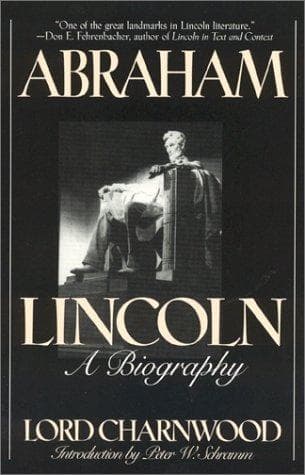
Abraham LincolnCharnwood, Godfrey Rathbone Benson, Baron
History
Abraham Lincoln
Charnwood, Godfrey Rathbone Benson, Baron
Lincoln, Abraham, 1809-1865; Presidents -- United States -- Biography
Shortly after, there reappeared upon the political scene a leader with
what might seem a more sympathetic outlook. This was Fremont,
Lincoln's predecessor as the Republican candidate for the Presidency.
Fremont was one of those men who make brilliant and romantic figures in
their earlier career, and later appear to have lost all solid
qualities. It must be recalled that, though scarcely a professional
soldier (for he had held a commission, but served only in the Ordnance
Survey) he had conducted a great exploring expedition, had seen
fighting as a free-lance in California, and, it is claimed, had with
his handful of men done much to win that great State from Mexico. Add
to this that he, a Southerner by birth, was known among the leaders who
had made California a free State, and it is plain how appropriate it
must have seemed when he was set to command the Western Department,
which for the moment meant Missouri. Here by want of competence, and,
which was more surprising, lethargy he had made a present of some
successes to a Southern invading force, and had sacrificed the
promising life of General Lyon. Lincoln, loath to remove him, had made
a good effort at helping him out by tactfully persuading a more
experienced general to serve as a subordinate on his staff. At the end
of August Fremont suddenly issued a proclamation establishing martial
law throughout Missouri. This contained other dangerous provisions,
but above all it liberated the slaves and confiscated the whole
property of all persons proved (before Court Martial) to have taken
active part with the enemy in the field. It is obvious that such a
measure was liable to shocking abuse, that it was certain to infuriate
many friends of the Union, and that it was in conflict with the law
which Congress had just passed on the subject. To Lincoln's mind it
presented the alarming prospect that it might turn the scale against
the Union cause in the still pending deliberations in Kentucky.
Lincoln's overpowering solicitude on such a point is among the proofs
that his understanding of the military situation, however elementary,
was sound. He wished, characteristically, that Fremont himself should
withdraw his Proclamation. He invited him to withdraw it in private
letters from which one sentence may be taken: "You speak of it as being
the only means of saving the Government. On the contrary, it is itself
the surrender of the Government. Can it be pretended that it is any
longer the Government of the United States--any government of
constitution and laws--wherein a general or a president may make
permanent rules of property by proclamation?" Fremont preferred to
make Lincoln publicly overrule him, which he did; and the inevitable
consequence followed. When some months later, the utter military
disorganisation, which Fremont let arise while he busied himself with
politics, and the scandalous waste, out of which his flatterers
Public-domain text, read in full here on John Shaqi.
Reviews
Reviews
No reviews yet
Be the first to share your thoughts on this work.
Elsewhere in the archive
Join the Discussion
Join the discussion
Sign in to leave a comment or review.
Sign InorCreate an account