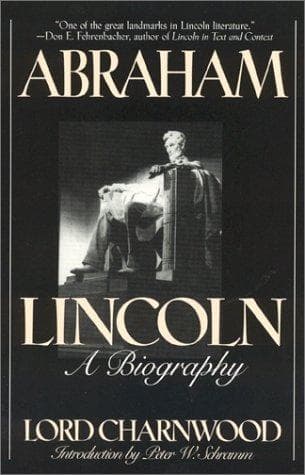
Abraham LincolnCharnwood, Godfrey Rathbone Benson, Baron
History
Abraham Lincoln
Charnwood, Godfrey Rathbone Benson, Baron
Lincoln, Abraham, 1809-1865; Presidents -- United States -- Biography
enriched themselves, compelled the President to remove him from his
command, Fremont became, for a time at least, to patriotic crowds and
to many intelligent, upright and earnest men from St. Louis to Boston,
the chivalrous and pure-hearted soldier of freedom, and Lincoln, the
soulless politician, dead to the cause of liberty, who, to gratify a
few wire-pulling friends, had struck this hero down on the eve of
victory to his army--an army which, by the way, he had reduced almost
to nonentity.
This salient instance explains well enough the nature of one half of
the trial which Lincoln throughout the war had to undergo. Pursuing
the restoration of the Union with a thoroughness which must estrange
from him the Democrats of the North, he was fated from the first to
estrange also Radicals who were generally as devoted to the Union as
himself and with whose over-mastering hatred of slavery he really
sympathised. In the following chapter we are more concerned with the
other half of his trial, the war itself. Of his minor political
difficulties few instances need be given--only it must be remembered
that they were many and involved, besides delicate questions of
principle, the careful sifting of much confident hearsay; and, though
the critics of public men are wont to forget it, that there are only
twenty-four hours in the day.
But the year 1861 was to close with a further vexation that must be
related. Secretary Cameron proved incapable on the business side of
war administration. Waste and alleged corruption called down upon him
a searching investigation by a committee of the House of
Representatives. He had not added to his own considerable riches, but
his political henchmen had grown fat. The displeasure with the whole
Administration was the greater because the war was not progressing
favourably, or at all. There were complaints of the Naval Department
also, but politicians testified their belief in the honesty of Welles
without saying a word for Cameron. There is every reason to think he
was not personally dishonourable. Lincoln believed in his complete
integrity, and so also did sterner critics, Chase, an apostle of
economy and uprightness, and Senator Sumner. But he had to go. He
opened the door for his removal by a circular to generals on the
subject of slaves, which was comparable to Fremont's Proclamation and
of which Lincoln had to forbid the issue. He accepted the appointment
of Minister to Russia, and when, before long, he returned, he justified
himself and Lincoln's judgment by his disinterested friendship and
support. He was removed from the War Office at the end of December and
a remarkable incident followed. While Lincoln's heart was still set on
his law practice, the prospect of appearing as something more than a
backwoods attorney smiled for a single moment on him. He was briefed
to appear in an important case outside Illinois with an eminent lawyer
from the East, Edwin M. Stanton; but he was not allowed to open his
Public-domain text, read in full here on John Shaqi.
Reviews
Reviews
No reviews yet
Be the first to share your thoughts on this work.
Elsewhere in the archive
Join the Discussion
Join the discussion
Sign in to leave a comment or review.
Sign InorCreate an account