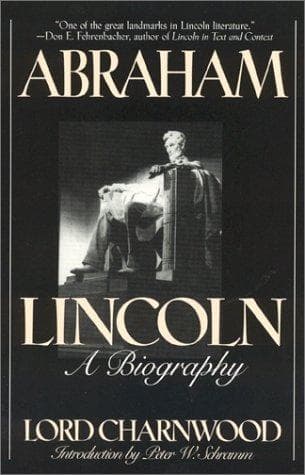
Abraham LincolnCharnwood, Godfrey Rathbone Benson, Baron
History
Abraham Lincoln
Charnwood, Godfrey Rathbone Benson, Baron
Lincoln, Abraham, 1809-1865; Presidents -- United States -- Biography
Immediately after Bull Run McClellan had been summoned to Washington to
command the army of the Potomac. In November, Scott, worn out by
infirmity, and finding his authority slighted by "my ambitious junior,"
retired, and thereupon McClellan, while retaining his immediate command
upon the Potomac, was made for the time General-in-Chief over all the
armies of the North. There were, it should be repeated, two other
principal armies besides that of the Potomac: the army of the Ohio, of
which General Buell was given command in July; and that of the West, to
which General Halleck was appointed, though Fremont seems to have
retained independent command in Missouri. All these armies were in an
early stage of formation and training, and from a purely military point
of view there could be no haste to undertake a movement of invasion
with any of them.
Three distinct views of military policy were presented to Lincoln in
the early days. Scott, as soon as it was clear that the South meant
real fighting, saw how serious its resistance would be. His military
judgment was in favour of a strictly defensive attitude before
Washington; of training the volunteers for at least four months in
healthy camps; and of then pushing a large army right down the
Mississippi valley to New Orleans, making the whole line of that river
secure, and establishing a pressure on the South between this Western
army and the naval blockade which must slowly have strangled the
Confederacy. He was aware that public impatience might not allow a
rigid adherence to his policy, and in fact, when his view was made
public before Bull Run, "Scott's Anaconda," coiling itself round the
Confederacy, was the subject of general derision. The view of the
Northern public and of the influential men in Congress was in favour of
speedy and, as it was hoped, decisive action, and this was understood
as involving, whatever else was done, an attempt soon to capture
Richmond. In McClellan's view, as in Scott's, the first object was the
full preparation of the Army, but he would have wished to wait till he
had a fully trained force of 273,000 men on the Potomac, and a powerful
fleet with many transports to support his movements; and, when he had
all this, to move southwards in irresistible force, both advancing
direct into Virginia and landing at points on the coast, subduing each
of the Atlantic States of the Confederacy in turn. If the indefinite
delay and the overwhelming force which his fancy pictured could have
been granted him, it is plain, the military critics have said, that "he
could not have destroyed the Southern armies--they would have withdrawn
inland, and the heart of the Confederacy would have remained
untouched." But neither the time nor the force for which he wished
could be allowed him. So he had to put aside his plan, but in some
ways perhaps it still influenced him.
Public-domain text, read in full here on John Shaqi.
Reviews
Reviews
No reviews yet
Be the first to share your thoughts on this work.
Elsewhere in the archive
Join the Discussion
Join the discussion
Sign in to leave a comment or review.
Sign InorCreate an account