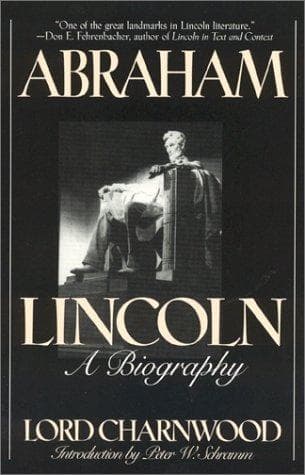
Abraham LincolnCharnwood, Godfrey Rathbone Benson, Baron
History
Abraham Lincoln
Charnwood, Godfrey Rathbone Benson, Baron
Lincoln, Abraham, 1809-1865; Presidents -- United States -- Biography
The pressure upon McClellan to move grew stronger and indeed more
justifiable month after month, and when at last, in March, 1862,
McClellan did move, the story of the severest adversity to the North,
of Lincoln's sorest trials, and, some still say, his gravest failures,
began. Its details will concern us more than those of any other part
of the war. But events in the West began earlier, proceeded faster,
and should be told first. Buell could not obtain from McClellan
permission to carry out his own scheme. He did, however, obtain
permission for Halleck, if he consented, to send flotillas up the
Tennessee and Cumberland Rivers to make a diversion while Buell, as
Lincoln had proposed and as McClellan had now ordered, marched upon
Eastern Tennessee. Halleck would not move. Buell prepared to move
alone, and in January, 1862, sent forward a small force under Thomas to
meet an equally small Confederate force that had advanced through
Cumberland Gap into Eastern Kentucky. Thomas won a complete victory,
most welcome as the first success since the defeat of Bull Run, at a
place called Mill Springs, far up the Cumberland River towards the
mountains. But at the end of January, while Buell was following up
with his forces rather widely dispersed because he expected no support
from Halleck, he was brought to a stop, for Halleck, without warning,
did make an important movement of his own, in which he would need
Buell's support.
The Cumberland and the Tennessee are navigable rivers which in their
lower course flow parallel in a northerly or north-westerly direction
to join the Ohio not far above its junction with the Mississippi at
Cairo. Fort Henry was a Confederate fort guarding the navigation of
the Tennessee near the northern boundary of the State of that name,
Fort Donelson was another on the Cumberland not far off. Ulysses
Simpson Grant, who had served with real distinction in the Mexican War,
had retired from the Army and had been more or less employed about his
father's leather store in Illinois and in the gloomy pursuit of
intoxication and of raising small sums from reluctant friends when he
met them. On the outbreak of the Civil War he suddenly pulled himself
together, and with some difficulty got employment from the Governor of
Illinois as a Major-General in the State Militia (obtaining Army rank
later). Since then, while serving under Halleck, he had shown sense
and promptitude in seizing an important point on the Ohio, upon which
the Confederates had designs. He had a quick eye for seeing important
points. Grant was now ordered or obtained permission from Halleck to
capture Fort Henry and Fort Donelson. By the sudden movements of Grant
and of the flotilla acting with him, the Confederates were forced to
abandon Fort Henry on February 6, 1862. Ten days later Fort Donelson
surrendered with nearly 10,000 prisoners, after a brilliant and nearly
successful sortie by the garrison, in which Grant showed, further,
Public-domain text, read in full here on John Shaqi.
Reviews
Reviews
No reviews yet
Be the first to share your thoughts on this work.
Elsewhere in the archive
Join the Discussion
Join the discussion
Sign in to leave a comment or review.
Sign InorCreate an account