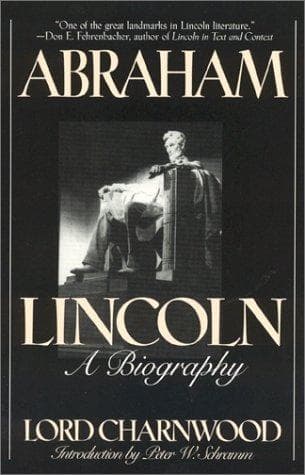
Abraham LincolnCharnwood, Godfrey Rathbone Benson, Baron
History
Abraham Lincoln
Charnwood, Godfrey Rathbone Benson, Baron
Lincoln, Abraham, 1809-1865; Presidents -- United States -- Biography
tenacity and a collected mind under the pressure of imminent calamity.
Halleck had given Grant little help. Buell was reluctant to detach any
of his volunteer troops from their comrades to act with a strange army,
and Halleck had not warned him of his intentions. Halleck soon applied
to Lincoln for the supreme command over the two Western armies with
Buell under him. This was given to him. Experience showed that one or
the other must command now that concerted action was necessary.
Nothing was known at Washington to set against Halleck's own claim of
the credit for the late successes. So Lincoln gave him the command,
though present knowledge shows clearly that Buell was the better man.
Grant had been left before Fort Donelson in a position of some danger
from the army under Albert Johnston; and, from needless fear of
Beauregard with a Confederate force under him yet further West, Halleck
let slip the chance of sending Grant in pursuit of Johnston, who was
falling back up the Cumberland valley. As it was, Johnston for a time
evacuated Nashville, further up the Cumberland, the chief town of
Tennessee and a great railway centre, which Buell promptly occupied;
Beauregard withdrew the Confederate troops from Columbus, a fortress of
great reputed strength on the Mississippi not far below Cairo, to
positions forty or fifty miles (as the crow flies) further down the
stream. Thus, as it was, some important steps had been gained in
securing that control of the navigation of the river which was one of
the great military objects of the North. Furthermore, successful work
was being done still further West by General Curtis in Missouri, who
drove an invading force back into Arkansas and inflicted a crushing
defeat upon them there in March. But a great stroke should now have
been struck. Buell, it is said, saw plainly that his forces and
Halleck's should have been concentrated as far up the Tennessee as
possible in an endeavour to seize upon the main railway system of the
Confederacy in the West. Halleck preferred, it would seem, to
concentrate upon nothing and to scatter his forces upon minor
enterprises, provided he did not risk any important engagement. An
important engagement with the hope of destroying an army of the enemy
was the very thing which, as Johnston's forces now stood, he should
have sought, but he appears to have been contented by the temporary
retirement of an unscathed enemy who would return again reinforced.
Buell was an unlucky man, and Halleck got quite all he deserved, so it
is possible that events have been described to us without enough regard
to Halleck's case as against Buell. But at any rate, while much should
have been happening, nothing very definite did happen till April 6,
when Albert Johnston, now strongly reinforced from the extreme South,
came upon Grant, who (it is not clear why) had lain encamped, without
entrenching, and not expecting immediate attack, near Shiloh, far up
Public-domain text, read in full here on John Shaqi.
Reviews
Reviews
No reviews yet
Be the first to share your thoughts on this work.
Elsewhere in the archive
Join the Discussion
Join the discussion
Sign in to leave a comment or review.
Sign InorCreate an account