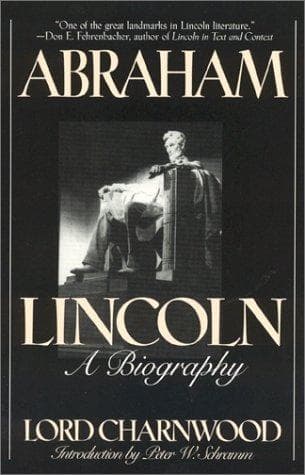
Abraham LincolnCharnwood, Godfrey Rathbone Benson, Baron
History
Abraham Lincoln
Charnwood, Godfrey Rathbone Benson, Baron
Lincoln, Abraham, 1809-1865; Presidents -- United States -- Biography
any way; but he was an unsatisfactory man to deal with in these
matters. There was a great mystery as to what became of the men sent
to him. In the idyllic phrase, which Lincoln once used of him or of
some other general, sending troops to him was "like shifting fleas
across a barn floor with a shovel--not half of them ever get there."
But his fault was graver than this; utterly ignoring the needs of the
West, he tried, as General-in-Chief, to divert to his own army the
recruits and the stores required for the other armies.
The difficulty with him went yet further; McClellan himself
deliberately set to work to destroy personal harmony between himself
and his Government. It counts for little that in private he soon set
down all the civil authorities as the "greatest set of incapables," and
so forth, but it counts for more that he was personally insolent to the
President. Lincoln had been in the habit, mistaken in this case but
natural in a chief who desires to be friendly, of calling at
McClellan's house rather than summoning him to his own. McClellan
acquired a habit of avoiding him, he treated his enquiries as idle
curiosity, and he probably thought, not without a grain of reason, that
Lincoln's way of discussing matters with many people led him into
indiscretion. So one evening when Lincoln and Seward were waiting at
the general's house for his return, McClellan came in and went
upstairs; a message was sent that the President would be glad to see
him; he said he was tired and would rather be excused that night.
Lincoln damped down his friends' indignation at this; he would, he once
said, "hold General McClellan's stirrup for him if he will only win us
victories." But he called no more at McClellan's, and a curious
abruptness in some of his orders later marks his unsuccessful effort to
deal with McClellan in another way. The slightly ridiculous light in
which the story shows Lincoln would not obscure to any soldier the full
gravity of such an incident. It was not merely foolish to treat a kind
superior rudely; a general who thus drew down a curtain between his own
mind and that of the Government evidently went a very long way to
ensure failure in war.
Public-domain text, read in full here on John Shaqi.
Reviews
Reviews
No reviews yet
Be the first to share your thoughts on this work.
Elsewhere in the archive
Join the Discussion
Join the discussion
Sign in to leave a comment or review.
Sign InorCreate an account