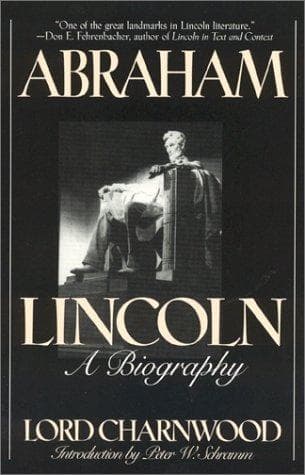
Abraham LincolnCharnwood, Godfrey Rathbone Benson, Baron
History
Abraham Lincoln
Charnwood, Godfrey Rathbone Benson, Baron
Lincoln, Abraham, 1809-1865; Presidents -- United States -- Biography
enemy and Lincoln had determined to send McDowell when he was induced
to keep him back by a diversion in the war which he had not expected,
and which indeed McClellan had advised him not to expect.
"Stonewall" Jackson's most famous campaign happened at this juncture,
and to save Washington, Lincoln and Stanton placed themselves, or were
placed, in the trying position of actually directing movements of
troops. There were to the south and south-west of Washington, besides
the troops under McDowell's command, two Northern forces respectively
commanded by Generals Banks and Fremont. These two men were among the
chief examples of those "political generals," the use of whom in this
early and necessarily blundering stage of the war has been the subject
of much comment. Banks was certainly a politician, a self-made man,
who had worked in a factory and who had risen to be at one time Speaker
of the House. He was now a general because as a powerful man in the
patriotic State of Massachusetts he brought with him many men, and
these were ready to obey him. On the other hand, he on several
occasions showed good judgment both in military matters and in the
questions of civil administration which came under him; his heart was
in his duty; and, though he held high commands almost to the end of the
war, want of competence was never imputed to him till the failure of a
very difficult enterprise on which he was despatched in 1864. He was
now in the lower valley of the Shenandoah, keeping a watch over a much
smaller force under Jackson higher up the valley. Fremont was in some
sense a soldier, but after his record in Missouri he should never have
been employed. His new appointment was one of Lincoln's greatest
mistakes, and it was a mistake of a characteristic kind. It will
easily be understood that there were real political reasons for not
leaving this popular champion of freedom unused and unrecognized.
These reasons should not have, and probably would not have, prevailed.
But Lincoln's personal reluctance to resist all entreaties on behalf of
his own forerunner and his own rival was great; and then Fremont came
to Lincoln and proposed to him a knight-errant's adventure to succour
the oppressed Unionists of Tennessee by an expedition through West
Virginia. So he was now to proceed there, but was kept for the present
in the mountains near the Shenandoah valley. The way in which the
forces under McDowell, Banks and Fremont were scattered on various
errands was unscientific; what could be done by Jackson, in
correspondence with Lee, was certainly unforeseen. At the beginning of
May, Jackson, who earlier in the spring had achieved some minor
successes in the Shenandoah valley and had raided West Virginia, began
a series of movements of which the brilliant skill and daring are
recorded in Colonel Henderson's famous book. With a small force,
surrounded by other forces, each of which, if concentrated, should have
Public-domain text, read in full here on John Shaqi.
Reviews
Reviews
No reviews yet
Be the first to share your thoughts on this work.
Elsewhere in the archive
Join the Discussion
Join the discussion
Sign in to leave a comment or review.
Sign InorCreate an account