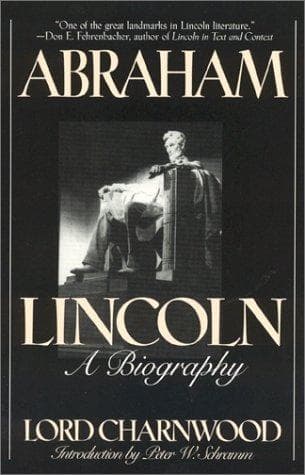
Abraham LincolnCharnwood, Godfrey Rathbone Benson, Baron
History
Abraham Lincoln
Charnwood, Godfrey Rathbone Benson, Baron
Lincoln, Abraham, 1809-1865; Presidents -- United States -- Biography
outnumbered him, he caught each in turn at a disadvantage, inflicted on
them several damaging blows, and put the startled President and
Secretary of War in fear for the safety of Washington. There seemed to
be no one available who could immediately be charged with the supreme
command of these three Northern forces, unless McDowell could have been
spared from where he was; so Lincoln with Stanton's help took upon
himself to ensure the co-operation of their three commanders by orders
from Washington. His self-reliance had now begun to reach its full
stature, his military good sense in comparison with McClellan's was
proving greater than he had supposed, and he had probably not
discovered its limitations. Presumably his plans now were, like an
amateur's, too complicated, and it is not worth while to discuss them.
But he was trying to cope with newly revealed military genius, and, so
far as can be told, he was only prevented from crushing the adventurous
Jackson by a piece of flat disobedience on the part of Fremont.
Fremont, having thus appropriately punished Lincoln, was removed, this
time finally, from command. Jackson, having successfully kept McDowell
from McClellan, had before the end of June escaped safe southward.
McClellan was nearing Richmond. Lee, by this time, had been set free
from Jefferson Davis' office and had taken over the command of Joseph
Johnston's army. Lincoln must have learnt a great deal, and he fully
realised that the forces not under McClellan in the East should be
under some single commander. Pope, an experienced soldier, had
succeeded well in the West; he was no longer necessary there, and there
was no adverse criticism upon him. He was in all respects a proper
choice, and he was now summoned to take command of what was to be
called the army of Virginia. A few days later, upon the advice, as it
seems, of Scott, Halleck himself was called from the West. His old
command was left to Grant and he himself was made General-in-Chief and
continued at Washington to the end of the war as an adviser of the
Government. All the progress in the West had been made under Halleck's
supervision, and his despatches had given an exaggerated impression of
his own achievement at Corinth. He had not seen active service before
the war, but he had a great name as an accomplished military writer; in
after years he was well known as a writer on international law. He is
not thought to have justified his appointment by showing sound judgment
about war, and Lincoln upon some later emergency told him in his direct
way that his military knowledge was useless if he could not give a
definite decision in doubtful circumstances. But whether Halleck's
abilities were great or small, Lincoln continued to use them, because
he found him "wholly for the service," without personal favour or
prejudice.
Public-domain text, read in full here on John Shaqi.
Reviews
Reviews
No reviews yet
Be the first to share your thoughts on this work.
Elsewhere in the archive
Join the Discussion
Join the discussion
Sign in to leave a comment or review.
Sign InorCreate an account