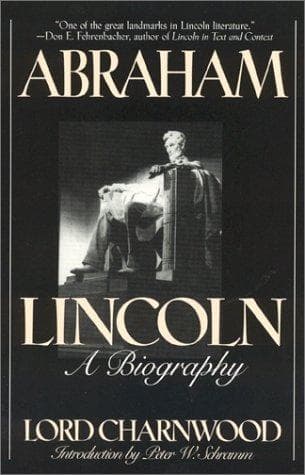
Abraham LincolnCharnwood, Godfrey Rathbone Benson, Baron
History
Abraham Lincoln
Charnwood, Godfrey Rathbone Benson, Baron
Lincoln, Abraham, 1809-1865; Presidents -- United States -- Biography
I feel any misfortune to you and
your army quite as keenly as you feel it yourself. If you have had a
drawn battle or repulse, it is the price we pay for the enemy not being
in Washington. We protected Washington and the enemy concentrated on
you. Had we stripped Washington, he would have been upon us before the
troops could have gotten to you. Less than a week ago you notified us
reinforcements were leaving Richmond to come in front of us. It is
the nature of the case, and neither you nor the Government are to
blame. Please tell me at once the present condition and aspect of
things."
Demands for an impossible number of reinforcements continued. Lincoln
explained to McClellan a few days later that they were impossible, and
added: "If in your frequent mention of responsibility you have the
impression that I blame you for not doing more than you can, please be
relieved of such an impression. I only beg that, in like manner, you
will not ask impossibilities of me." Much argument upon Lincoln's next
important act may be saved by the simple observations that the problem
in regard to the defence of Washington was real, that McClellan's
propensity to ask for the impossible was also real, and that Lincoln's
patient and loyal attitude to him was real too.
Five days after his arrival at Harrison's Landing, McClellan wrote
Lincoln a long letter. It was a treatise upon Lincoln's political
duties. It was written as "on the brink of eternity." He was not then
in fact in any danger, and possibly he had composed it seven days
before as his political testament; and apprehensions, free from
personal fear, excuse, without quite redeeming, its inappropriateness.
The President is before all things not to abandon the cause. But the
cause should be fought for upon Christian principles. Christian
principles exclude warfare on private property. More especially do
they exclude measures for emancipating slaves. And if the President
gives way to radical views on slavery, he will get no soldiers. Then
follows a mandate to the President to appoint a Commander-in-Chief, not
necessarily the writer. Such a summary does injustice to a certain
elevation of tone in the letter, but that elevation is itself slightly
strained. McClellan, whatever his private opinions, had not meddled
with politics before he left Washington. The question why in this
military crisis he should have written what a Democratic politician
might have composed as a party manifesto must later have caused Lincoln
some thought, but it apparently did not enter into the decision he next
took. He arrived himself at Harrison's Landing next day. McClellan
handed him the letter. Lincoln read it, and said that he was obliged
to him. McClellan sent a copy to his wife as "a very important record."
Public-domain text, read in full here on John Shaqi.
Reviews
Reviews
No reviews yet
Be the first to share your thoughts on this work.
Elsewhere in the archive
Join the Discussion
Join the discussion
Sign in to leave a comment or review.
Sign InorCreate an account