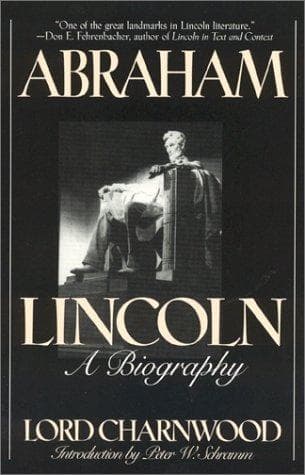
Abraham LincolnCharnwood, Godfrey Rathbone Benson, Baron
History
Abraham Lincoln
Charnwood, Godfrey Rathbone Benson, Baron
Lincoln, Abraham, 1809-1865; Presidents -- United States -- Biography
McClellan was slowly but steadily nearing Richmond. From June 26 to
July 2 there took place a series of engagements between Lee and
McClellan, or rather the commanders under him, known as the Seven Days'
Battles. The fortunes of the fighting varied greatly, but the upshot
is that, though the corps on McClellan's left won a strong position not
far from Richmond, the sudden approach of Jackson's forces upon
McClellan's right flank, which began on the 26th, placed him in what
appears to have been, as he himself thought it, a situation of great
danger. Lee is said to have "read McClellan like an open book,"
playing upon his caution, which made him, while his subordinates
fought, more anxious to secure their retreat than to seize upon any
advantage they gained. But Lee's reading deceived him in one respect.
He had counted upon McClellan's retreating, but thought he would
retreat under difficulties right down the Peninsula to his original
base and be thoroughly cut up on the way. But on July 2 McClellan with
great skill withdrew his whole army to Harrison's Landing far up the
James estuary, having effected with the Navy a complete transference of
his base. Here his army lay in a position of security; they might yet
threaten Richmond, and McClellan's soldiers still believed in him. But
the South was led by a great commander and had now learned to give him
unbounded confidence; there was some excuse for a panic in Wall Street,
and every reason for dejection in the North.
On the third of the Seven Days, McClellan, much moved by the sight of
dead and wounded comrades, sent a gloomy telegram to the Secretary of
War, appealing with excessive eloquence for more men. "I only wish to
say to the President," he remarked in it, "that I think he is wrong in
regarding me as ungenerous when I said that my force was too weak." He
concluded: "If I save the army now, I tell you plainly that I owe no
thanks to you nor to any other persons in Washington. You have done
your best to sacrifice this army." Stanton still expressed the
extraordinary hope that Richmond would fall in a day or two. He had
lately committed the folly of suspending enlistment, an act which,
though of course there is an explanation of it, must rank as the one
first-rate blunder of Lincoln's Administration. He was now negotiating
through the astute Seward for offers from the State Governors of a levy
of 300,000 men to follow up McClellan's success. Lincoln, as was his
way, feared the worst. He seems at one moment to have had fears for
McClellan's sanity. But he telegraphed, himself, an answer to him,
which affords as fair an example as can be given of his characteristic
manner. "Save your army at all events. Will send reinforcements as
fast as we can. Of course they cannot reach you to-day or to-morrow,
or next day. I have not said you were ungenerous for saying you needed
reinforcements. I thought you were ungenerous in assuming that I did
not send them as fast as I could.
Public-domain text, read in full here on John Shaqi.
Reviews
Reviews
No reviews yet
Be the first to share your thoughts on this work.
Elsewhere in the archive
Join the Discussion
Join the discussion
Sign in to leave a comment or review.
Sign InorCreate an account