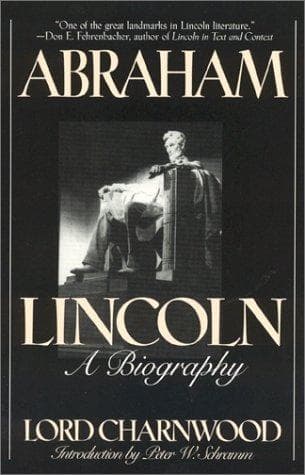
Abraham LincolnCharnwood, Godfrey Rathbone Benson, Baron
History
Abraham Lincoln
Charnwood, Godfrey Rathbone Benson, Baron
Lincoln, Abraham, 1809-1865; Presidents -- United States -- Biography
Pope had now set vigorously to work collecting and pulling together his
forces, which had previously been scattered under different commanders
in the north of Virginia. He was guilty of a General Order which
shocked people by its boastfulness, insulted the Eastern soldiers by a
comparison with their Western comrades, and threatened harsh and most
unjust treatment of the civil population of Virginia. But upon the
whole he created confidence, for he was an officer well trained in his
profession as well as an energetic man. The problem was now to effect
as quickly as possible the union of Pope's troops and McClellan's in an
overwhelming force. Pope was anxious to keep McClellan unmolested
while he embarked his men. So, to occupy the enemy, he pushed boldly
into Virginia; he pushed too far, placed himself in great danger from
the lightning movements which Lee now habitually employed Jackson to
execute, but extricated himself with much promptitude, though with some
considerable losses. McClellan had not been deprived of command; he
was in the curious and annoying position of having to transfer troops
to Pope till, for a moment, not a man remained under him, but the
process of embarking and transferring them gave full scope for energy
and skill. McClellan, as it appeared to Lincoln, performed his task
very slowly. This was not the judgment of impatience, for McClellan
caused the delay by repeated and perverse disobedience to Halleck's
orders. But the day drew near when 150,000 men might be concentrated
under Pope against Lee's 55,000. The stroke which Lee now struck after
earnest consultation with Jackson has been said to have been "perhaps
the most daring in the history of warfare." He divided his army almost
under the enemy's eyes and sent Jackson by a circuitous route to cut
Pope's communications with Washington. Then followed an intricate
tactical game, in which each side was bewildered as to the movements of
the other. Pope became exasperated and abandoned his prudence. He
turned on his enemy when he should and could have withdrawn to a safe
position and waited. On August 29 and 30, in the ominous neighbourhood
of the Bull Run and of Manassas, he sustained a heavy defeat. Then he
abandoned hope before he need have done so, and, alleging that his men
were demoralised, begged to be withdrawn within the defences of
Washington, where he arrived on September 3, and, as was inevitable in
the condition of his army, was relieved of his command. McClellan, in
Lincoln's opinion, had now been guilty of the offence which that
generous mind would find it hardest to forgive. He had not bestirred
himself to get his men to Pope. In Lincoln's belief at the time he had
wished Pope to fail. McClellan, who reached Washington at the crisis
of Pope's difficulties, was consulted, and said to Lincoln that Pope
must be left to get out of his scrape as best he could. It was perhaps
only an awkward phrase, but it did not soften Lincoln.
Public-domain text, read in full here on John Shaqi.
Reviews
Reviews
No reviews yet
Be the first to share your thoughts on this work.
Elsewhere in the archive
Join the Discussion
Join the discussion
Sign in to leave a comment or review.
Sign InorCreate an account