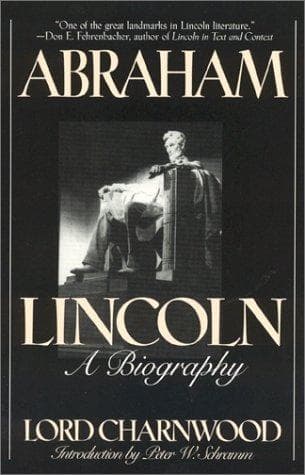
Abraham LincolnCharnwood, Godfrey Rathbone Benson, Baron
History
Abraham Lincoln
Charnwood, Godfrey Rathbone Benson, Baron
Lincoln, Abraham, 1809-1865; Presidents -- United States -- Biography
Washington was now too strongly held to be attacked, but Lee determined
to invade Maryland. At least this would keep Virginia safe during
harvest time. It might win him many recruits in Maryland. It would
frighten the North, all the more because a Confederate force further
west was at that same time invading Kentucky; it might accomplish there
was no saying how much. This much, one may gather from the "Life of
Lord John Russell," any great victory of the South on Northern soil
would probably have accomplished: the Confederacy would have been
recognised, as Jefferson Davis longed for it to be, by European Powers.
Lincoln now acted in total disregard of his Cabinet and of all
Washington, and in equal disregard of any false notions of dignity. By
word of mouth he directed McClellan to take command of all the troops
at Washington. His opinion of McClellan had not altered, but, as he
said to his private secretaries, if McClellan could not fight himself,
he excelled in making others ready to fight. No other step could have
succeeded so quickly in restoring order and confidence to the Army.
Few or no instructions were given to McClellan. He was simply allowed
the freest possible hand, and was watched with keen solicitude as to
how he would rise to his opportunity.
Lee, in his advance, expected his opponent to be slow. He actually
again divided his small army, leaving Jackson with a part of it behind
for a while to capture, as he did, the Northern fort at Harper's Ferry.
A Northern private picked up a packet of cigars dropped by some
Southern officer with a piece of paper round it. The paper was a copy
of an order of Lee's which revealed to McClellan the opportunity now
given him of crushing Lee in detail. But he did not rouse himself. He
was somewhat hampered by lack of cavalry, and his greatest quality in
the field was his care not to give chances to the enemy. His want of
energy allowed Lee time to discover what, had happened and fall back a
little towards Harper's Ferry. Yet Lee dared, without having yet
reunited his forces, to stop at a point where McClellan must be tempted
to give him battle, and where, if he could only stand against
McClellan, Jackson would be in a position to deliver a deadly
counter-stroke. Lee knew that for the South the chance of rapid
success was worth any risk. McClellan, however, moved so slowly that
Jackson was able to join Lee before the battle. The Northern army came
up with them near the north bank of the Potomac on the Antietam Creek,
a small tributary of that river, about sixty miles north-east of
Washington. There, on September 17, 1862, McClellan ordered an attack,
to which he did not attempt to give his personal direction. His corps
commanders led assaults on Lee's position at different times and in so
disconnected a manner that each was repulsed singly. But on the
following morning Lee found himself in a situation which determined him
to retreat.
Public-domain text, read in full here on John Shaqi.
Reviews
Reviews
No reviews yet
Be the first to share your thoughts on this work.
Elsewhere in the archive
Join the Discussion
Join the discussion
Sign in to leave a comment or review.
Sign InorCreate an account