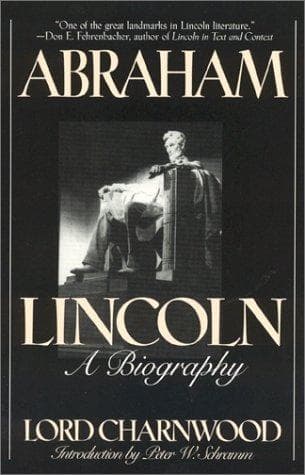
Abraham LincolnCharnwood, Godfrey Rathbone Benson, Baron
History
Abraham Lincoln
Charnwood, Godfrey Rathbone Benson, Baron
Lincoln, Abraham, 1809-1865; Presidents -- United States -- Biography
When the news of a second battle of Bull Run reached England it seemed
at first to Lord John Russell that the failure of the North was
certain, and he asked Palmerston and his colleagues to consider whether
they must not soon recognise the Confederacy, and whether mediation in
the interest of peace and humanity might not perhaps follow. But
within two months all thoughts of recognising the Confederacy had been
so completely put aside that even Fredericksburg and Chancellorsville
caused no renewal of the suggestion, and an invitation from Louis
Napoleon to joint action of this kind between England and France had
once for all been rejected. The battle of Antietam had been fought in
the meantime. This made men think that the South could no more win a
speedy and decisive success than the North, and that victory must rest
in the end with the side that could last. But that was not all; the
battle of Antietam was followed within five days by an event which made
it impossible for any Government of this country to take action
unfriendly to the North.
On September 22, 1862, Abraham Lincoln set his hand to a Proclamation
of which the principal words were these: "That, on the first day of
January in the year of our Lord one thousand eight hundred and
sixty-three, all persons held as slaves within any State, or designated
part of a State, the people whereof shall then be in rebellion against
the United States, shall be then, thenceforward and forever free."
The policy and the true effect of this act cannot be understood without
some examination. Still less so can the course of the man who will
always be remembered as its author. First, in regard to the legal
effect of the Proclamation; in normal times the President would of
course not have had the power, which even the Legislature did not
possess, to set free a single slave; the Proclamation was an act of war
on his part, as Commander-in-Chief of the forces, by which slaves were
to be taken from people at war with the United States, just as horses
or carts might be taken, to subtract from their resources and add to
those of the United States. In a curiously prophetic manner,
ex-President John Quincy Adams had argued in Congress many years before
that, if rebellion ever arose, this very thing might be done. Adams
would probably have claimed that the command of the President became
law in the States which took part in the rebellion. Lincoln only
claimed legal force for his Proclamation in so far as it was an act of
war based on sufficient necessity and plainly tending to help the
Northern arms. If the legal question had ever been tried out, the
Courts would no doubt have had to hold that at least those slaves who
obtained actual freedom under the Proclamation became free in law; for
it was certainly in good faith an act of war, and the military result
justified it. A large amount of labour was withdrawn from the industry
necessary to the South, and by the end of the war 180,000 coloured
Public-domain text, read in full here on John Shaqi.
Reviews
Reviews
No reviews yet
Be the first to share your thoughts on this work.
Elsewhere in the archive
Join the Discussion
Join the discussion
Sign in to leave a comment or review.
Sign InorCreate an account