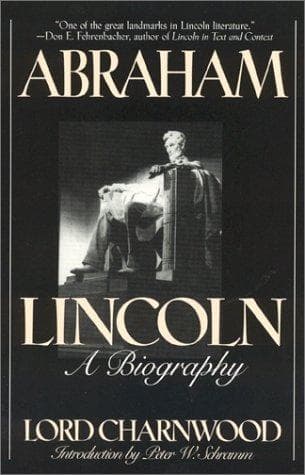
Abraham LincolnCharnwood, Godfrey Rathbone Benson, Baron
History
Abraham Lincoln
Charnwood, Godfrey Rathbone Benson, Baron
Lincoln, Abraham, 1809-1865; Presidents -- United States -- Biography
troops were in arms for the North, rendering services, especially in
occupying conquered territory that was unhealthy for white troops,
without which, in Lincoln's opinion, the war could never have been
finished. The Proclamation had indeed an indirect effect more
far-reaching than this; it committed the North to a course from which
there could be no turning back, except by surrender; it made it a
political certainty that by one means or another slavery would be ended
if the North won. But in Lincoln's view of his duty as President, this
ulterior consequence was not to determine his action. The fateful step
by which the end of slavery was precipitated would not have taken the
form it did take if it had not come to commend itself to him as a
military measure conducing to the suppression of rebellion.
On the broader grounds on which we naturally look at this measure, many
people in the North had, as we have seen, been anxious from the
beginning that he should adopt an active policy of freeing Southern
slaves. It was intolerable to think that the war might end and leave
slavery where it was. To convert the war into a crusade against
slavery seemed to many the best way of arousing and uniting the North.
This argument was reinforced by some of the American Ministers abroad.
They were aware that people in Europe misunderstood and disliked the
Constitutional propriety with which the Union government insisted that
it was not attacking the domestic institutions of Southern States.
English people did not know the American Constitution, and when told
that the North did not threaten to abolish slavery would answer "Why
not?" Many Englishmen, who might dislike the North and might have
their doubts as to whether slavery was as bad as it was said to be,
would none the less have respected men who would fight against it.
They had no interest in the attempt of some of their own seceded
Colonists to coerce, upon some metaphysical ground of law, others who
in their turn wished to secede from them. Seward, with wonderful
misjudgment, had instructed Ministers abroad to explain that no attack
was threatened on slavery, for he was afraid that the purchasers of
cotton in Europe would feel threatened in their selfish interests; the
agents of the South were astute enough to take the same line and insist
like him that the North was no more hostile to slavery than the South.
If this misunderstanding were removed English hostility to the North
would never again take a dangerous form. Lincoln, who knew less of
affairs but more of men than Seward, was easily made to see this. Yet,
with full knowledge of the reasons for adopting a decided policy
against slavery, Lincoln waited through seventeen months of the war
till the moment had come for him to strike his blow.
Public-domain text, read in full here on John Shaqi.
Reviews
Reviews
No reviews yet
Be the first to share your thoughts on this work.
Elsewhere in the archive
Join the Discussion
Join the discussion
Sign in to leave a comment or review.
Sign InorCreate an account