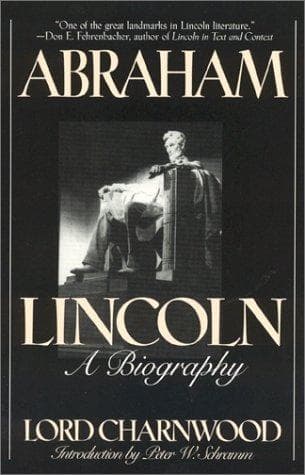
Abraham LincolnCharnwood, Godfrey Rathbone Benson, Baron
History
Abraham Lincoln
Charnwood, Godfrey Rathbone Benson, Baron
Lincoln, Abraham, 1809-1865; Presidents -- United States -- Biography
On the day that he received the news of the battle of Antietam, the
draft Proclamation was taken from its drawer and studied afresh; his
visit to McClellan on the battlefield intervened; but on the fifth day
after the battle the Cabinet was suddenly called together. When the
Ministers had assembled Lincoln first entertained them by reading the
short chapter of Artemus Ward entitled "High-handed Outrage at Utica."
It is less amusing than most of Artemus Ward; but it had just appeared;
it pleased all the Ministers except Stanton, to whom the frivolous
reading he sometimes had to hear from Lincoln was a standing vexation;
and it was precisely that sort of relief to which Lincoln's mind when
overwrought could always turn. Having thus composed himself for
business, he reminded his Cabinet that he had, as they were aware,
thought a great deal about the relation of the war to slavery, and had
a few weeks before read them a draft Proclamation on this subject.
Ever since then, he said, his mind had been occupied on the matter,
and, though he wished it were a better time, he thought the time had
come now. "When the rebel army was at Frederick," he is related to
have continued, "I determined, as soon as it should be driven out of
Maryland, to issue a Proclamation of Emancipation such as I thought
likely to be most useful. I said nothing to any one, but I made the
promise to myself and"--here he hesitated a little--"to my Maker. The
rebel army is now driven out, and I am going to fulfil that promise. I
have got you together to hear what I have written down. I do not wish
your advice about the main matter, for that I have determined for
myself. This I say without intending anything but respect for any one
of you." He then invited their suggestions upon the expressions used
in his draft and other minor matters, and concluded: "One other
observation I will make. I know very well that many others might in
this matter, as in others, do better than I can; and if I was satisfied
that the public confidence was more fully possessed by any one of them
than by me, and knew of any constitutional way in which he could be put
in my place, he should have it. I would gladly yield it to him. But
though I believe I have not so much of the confidence of the people as
I had some time since, I do not know that, all things considered, any
other person has more; and, however this may be, there is no way in
which I can have any other man put where I am. I am here; I must do
the best I can, and bear the responsibility of taking the course which
I feel I ought to take." Then he read his draft, and in the long
discussion which followed, and owing to which a few slight changes were
made in it, he told them further, without any false reserve, just how
he came to his decision. In his great perplexity he had gone on his
knees, before the battle of Antietam, and, like a child, he had
promised that if a victory was given which drove the enemy out of
Public-domain text, read in full here on John Shaqi.
Reviews
Reviews
No reviews yet
Be the first to share your thoughts on this work.
Elsewhere in the archive
Join the Discussion
Join the discussion
Sign in to leave a comment or review.
Sign InorCreate an account