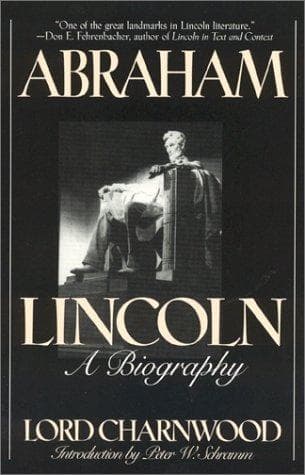
Abraham LincolnCharnwood, Godfrey Rathbone Benson, Baron
History
Abraham Lincoln
Charnwood, Godfrey Rathbone Benson, Baron
Lincoln, Abraham, 1809-1865; Presidents -- United States -- Biography
The fate of Jefferson's party (at first called Republican but by no means
to be confused with the Republican party which will concern us later) was
far different, for the Democratic party, represented by the President of
the United States at this moment, claims to descend from it in unbroken
apostolic succession. But we need not pause to trace the connecting
thread between them, real as it is, for parties are not to be regarded as
individuals. Indeed the personality of Thomas Jefferson, Secretary of
State in Washington's Cabinet, impressed itself, during his life and long
after, upon all America more than that of any other man. Democrats
to-day have described Lincoln, who by no means belonged to their party,
as Jefferson's spiritual heir; and Lincoln would have welcomed the
description.
No biographer has achieved an understanding presentment of Jefferson's
curious character, which as presented by unfriendly critics is an
unpleasing combination of contrasting elements. A tall and active
fellow, a good horseman and a good shot, living through seven years of
civil war, which he had himself heralded in, without the inclination to
strike a blow; a scholar, musician, and mathematician, without delicacy,
elevation, or precision of thought or language; a man of intense
ambition, without either administrative capacity or the courage to assert
himself in counsel or in debate; a dealer in philanthropic sentiment,
privately malignant and vindictive. This is not as a whole a credible
portrait; it cannot stand for the man as his friends knew him; but there
is evidence for each feature of it, and it remains impossible for a
foreigner to think of Jefferson and not compare him to his disadvantage
with the antagonist whom he eclipsed. By pertinacious industry, however,
working chiefly through private correspondence, he constructed a great
party, dominated a nation, and dominated it mainly for good. For the
rapid and complete triumph of Jefferson's party over its opponents
signifies a very definite and lasting conversion of the main stream of
American public opinion to what may be called the sane element in the
principles of the French Revolution. At the time when he set himself to
counterwork Hamilton, American statesmanship was likely to be directed
only to making Government strong and to ensuring the stability of the
business world; for reaction against the bloody absurdities that had
happened in France was strong in America, and in English thought, which
still had influence in America, it was all-powerful. Against this he
asserted an intense belief in the value of freedom, in the equal claim of
men of all conditions to the consideration of government, and in the
supreme importance to government of the consenting mind of the governed.
And he made this sense so definitely a part of the national stock of
ideas that, while the older-established principles of strong and sound
government were not lost to sight, they were consciously rated as
Public-domain text, read in full here on John Shaqi.
Reviews
Reviews
No reviews yet
Be the first to share your thoughts on this work.
Join the Discussion
Join the discussion
Sign in to leave a comment or review.
Sign InorCreate an account