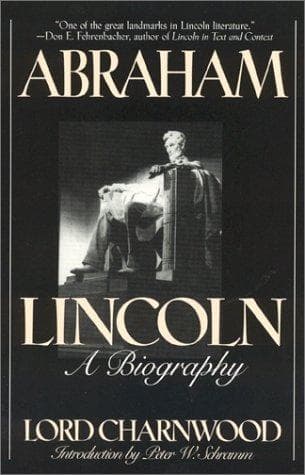
Abraham LincolnCharnwood, Godfrey Rathbone Benson, Baron
History
Abraham Lincoln
Charnwood, Godfrey Rathbone Benson, Baron
Lincoln, Abraham, 1809-1865; Presidents -- United States -- Biography
On October 8 a battle, which began in an accidental minor conflict, took
place between Buell with 58,000 men and Bragg with considerably less than
half that number of tried veterans. Buell made little use of his
superior numbers, for which the fault may have lain with the corps
commander who first became engaged and who did not report at once to him;
the part of Buell's army which bore the brunt of the fighting suffered
heavy losses, which made a painful impression in the North, and the
public outcry against him, which had begun as soon as Kentucky was
invaded by the Confederates, now increased. After the battle Bragg fell
back and effected a junction with Kirby Smith. Their joint forces were
not very far inferior to Buell's in numbers, but after a few more days
Bragg determined to evacuate Kentucky, in which his hope of raising many
recruits had been disappointed. Buell, on perceiving his intention,
pursued him some distance, but, finding the roads bad for the movement of
large bodies of troops, finally took up a position at Bowling Green, on
the railway to the north of Nashville, intending later in the autumn to
move a little south of Nashville and there to wait for the spring before
again moving on Chattanooga. He was urged from Washington to press
forward towards Chattanooga at once, but replied decidedly that he was
unable to do so, and added that if a change of command was desired the
present was a suitable time for it. At the end of October he was removed
from command. In the meantime the Confederate forces that had been left
to oppose Grant had attacked him and been signally defeated in two
engagements, in each of which General Rosecrans, who was serving under
Grant, was in immediate command on the Northern side. Rosecrans, who
therefore began to be looked upon as a promising general, and indeed was
one of those who, in the chatter of the time, were occasionally spoken of
as suitable for a "military dictatorship," was now put in Buell's place,
which Thomas had once refused. He advanced to Nashville, but was as firm
as Buell in refusing to go further till he had accumulated rations enough
to make him for a time independent of the railway. Ultimately he moved
on Murfreesborough, some thirty miles further in the direction of
Chattanooga. Here on December 31, 1862, Bragg, with somewhat inferior
numbers, attacked him and gained an initial success, which Rosecrans and
his subordinates, Thomas and Sheridan, were able to prevent him from
making good. Bragg's losses were heavy, and, after waiting a few days in
the hope that Rosecrans might retreat first, he fell back to a point near
the Cumberland mountains a little in advance of Chattanooga. Thus the
battle of Murfreesborough counted as a victory to the North, a slight
set-off to the disaster at Fredericksburg a little while before. But it
had no very striking consequences. For over six months Rosecrans
proceeded no further. The Northern armies remained in more secure
Public-domain text, read in full here on John Shaqi.
Reviews
Reviews
No reviews yet
Be the first to share your thoughts on this work.
Elsewhere in the archive
Join the Discussion
Join the discussion
Sign in to leave a comment or review.
Sign InorCreate an account