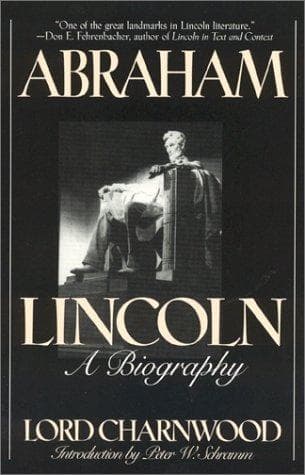
Abraham LincolnCharnwood, Godfrey Rathbone Benson, Baron
History
Abraham Lincoln
Charnwood, Godfrey Rathbone Benson, Baron
Lincoln, Abraham, 1809-1865; Presidents -- United States -- Biography
possession of all Tennessee west of the mountains than they had obtained
in the first half of 1862; but the length of their communications and the
great superiority of the South in cavalry, which could threaten those
communications, suspended their further advance. Lincoln urged that
their army could subsist on the country which it invaded, but Buell and
Rosecrans treated the idea as impracticable; in fact, till a little later
all Northern generals so regarded it.
Thus Chattanooga, which it was hoped would be occupied soon after Halleck
had occupied Corinth, remained in Southern hands for more than a year
after that, notwithstanding the removal of Buell, to whom this
disappointment and the mortifying invasion of Kentucky were at first
attributed. This was rightly felt to be unsatisfactory, but the chief
blame that can now be imputed falls upon the mistakes of Halleck while he
was still commanding in the West. There is no reason to suppose that
Buell had any exceptional amount of intuition or of energy and it was
right to demand that a general with both these qualities should be
appointed if he could be found. But he was at least a prudent officer,
of fair capacity, doing his best. The criticisms upon him, of which the
well informed were lavish, were uttered without appreciation of practical
difficulties or of the standard by which he was really to be judged. So,
with far more justice than McClellan, he has been numbered among the
misused generals. Lincoln, there is no doubt, had watched his
proceedings, as he watched those of Rosecrans after him, with a feeling
of impatience, and set him down as unenterprising and obstinate. In one
point his Administration was much to blame in its treatment of the
Western commanders. It became common political talk that the way to get
victories was to treat unsuccessful generals almost as harshly as the
French in the Revolution were understood to have treated them. Lincoln
did not go thus far, but it was probably with his authority that before
Buell was removed Halleck, with reluctance on his own part, wrote a
letter referring to this prevalent idea and calculated to put about among
the Western commanders an expectation that whichever of them first did
something notable would be put over his less successful colleagues.
Later on, and, as we can hardly doubt, with Lincoln's consent, Grant and
Rosecrans were each informed that the first of them to win a victory
would get the vacant major-generalship in the United States Army in place
of his present volunteer rank. This was not the way to handle men with
proper professional pride, and it is one of those cases, which are
strangely few, where Lincoln made the sort of mistake that might have
been expected from his want of training and not from his native
generosity. But in the main his treatment of this difficult question was
sound. Sharing as he did the prevailing impatience with Buell, he had no
Public-domain text, read in full here on John Shaqi.
Reviews
Reviews
No reviews yet
Be the first to share your thoughts on this work.
Elsewhere in the archive
Join the Discussion
Join the discussion
Sign in to leave a comment or review.
Sign InorCreate an account