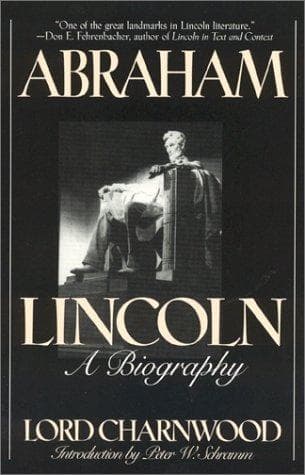
Abraham LincolnCharnwood, Godfrey Rathbone Benson, Baron
History
Abraham Lincoln
Charnwood, Godfrey Rathbone Benson, Baron
Lincoln, Abraham, 1809-1865; Presidents -- United States -- Biography
We have come, however, to the end, not of all the clamour against
Lincoln, but of his own worst perplexities. In passing to the operations
further west we are passing to an instance in which Lincoln felt it right
to stand to the end by a decried commander, and that decried commander
proved to possess the very qualities for which he had vainly looked in
others. The reverse side of General Grant's fame is well enough known to
the world. Before the war he had been living under a cloud. In the
autumn of 1862, while his army lay between Corinth and Memphis, the cloud
still rested on his reputation. In spite of the glory he had won for a
moment at Fort Donelson, large circles were ready to speak of him simply
as an "incompetent and disagreeable man." The crowning work of his life
was accomplished with terrible bloodshed which was often attributed to
callousness and incapacity on his part. The eight years of his
Presidency afterwards, which cannot properly be discussed here, added at
the best no lustre to his memory. Later still, when he visited Europe as
a celebrity the general impression which he created seems to be contained
in the words "a rude man." Thus the Grant that we discover in the
recollections of a few loyal and loving friends, and in the memoirs which
he himself began when late in life he lost his money and which he
finished with the pains of death upon him, is a surprising, in some ways
pathetic, figure. He had been a shy country boy, ready enough at all the
work of a farm and good with horses, but with none of the business
aptitude that make a successful farmer, when his father made him go to
West Point. Here he showed no great promise and made few friends; his
health became delicate, and he wanted to leave the army and become a
teacher of mathematics. But the Mexican War, one of the most unjust in
all history, as he afterwards said, broke out, and--so he later
thought--saved his life from consumption by keeping him in the open air.
After that he did retire, failed at farming and other ventures, and at
thirty-nine, when the Civil War began, was as has been seen, a
shabby-looking, shiftless fellow, pretty far gone in the habit of drink,
and more or less occupied about a leather business of his father's.
Rough in appearance and in manner he remained--the very opposite of
smart, the very opposite of versatile, the very opposite of expansive in
speech or social intercourse. Unlike many rough people, he had a really
simple character--truthful, modest, and kind; without varied interests,
or complicated emotions, or much sense of fun, but thinking intensely on
the problems that he did see before him, and in his silent way keenly
sensitive on most of the points on which it is well to be sensitive. His
friends reckoned up the very few occasions on which he was ever seen to
be angry; only one could be recalled on which he was angry on his own
account; the cruelty of a driver to animals in his supply train,
Public-domain text, read in full here on John Shaqi.
Reviews
Reviews
No reviews yet
Be the first to share your thoughts on this work.
Elsewhere in the archive
Join the Discussion
Join the discussion
Sign in to leave a comment or review.
Sign InorCreate an account