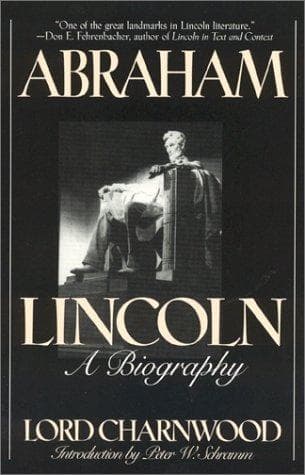
Abraham LincolnCharnwood, Godfrey Rathbone Benson, Baron
History
Abraham Lincoln
Charnwood, Godfrey Rathbone Benson, Baron
Lincoln, Abraham, 1809-1865; Presidents -- United States -- Biography
The affectionate confidence which existed between Lee and "Stonewall"
Jackson till the latter was killed at Chancellorsville had a parallel in
the endearing friendship which sprung up between Grant and his principal
subordinate, William T. Sherman, who was to bear a hardly less momentous
part than his own in the conclusion of the war. Sherman was a man of
quick wits and fancy, bright and mercurial disposition, capable of being
a delightful companion to children, and capable of being sharp and
inconsiderate to duller subordinates. It is a high tribute both to this
brilliant soldier and to Grant himself that he always regarded Grant as
having made him, not only by his confidence but by his example.
As has been said, Grant was required to remain on the defensive between
Memphis and Corinth, which mark the line of the Northern frontier at this
period, while Buell was advancing on Chattanooga. Later, while the
Confederates were invading Kentucky further east, attacks were also
directed against Grant to keep him quiet. These were defeated, though
Grant was unable to follow up his success at the time. When the invasion
of Kentucky had collapsed and the Confederates under Bragg were
retreating before Buell and his successor out of Middle Tennessee, it
became possible for Grant and for Halleck and the Government at
Washington to look to completing the conquest of the Mississippi River.
The importance to the Confederates of a hold upon the Mississippi has
been pointed out; if it were lost the whole of far South-West would
manifestly be lost with it; in the North, on the other hand, public
sentiment was strongly set upon freeing the navigation of the great
river. The Confederacy now held the river from the fortress of
Vicksburg, which after taking New Orleans Admiral Farragut had attacked
in vain, down to Port Hudson, 120 miles further south, where the
Confederate forces had since then seized and fortified another point of
vantage. Vicksburg, it will be observed, lies 175 to 180 miles south of
Memphis, or from Grand Junction, between Memphis and Corinth, the points
in the occupation of the North which must serve Grant as a base. At
Vicksburg itself, and for some distance south of it, a line of bluffs or
steep-sided hills lying east of the Mississippi comes right up to the
edge of the river. The river as it approaches these bluffs makes a
sudden bend to the north-east and then again to the south-west, so that
two successive reaches of the stream, each from three to four miles long,
were commanded by the Vicksburg guns, 200 feet above the valley; the
eastward or landward side of the fortress was also well situated for
defence. To the north of Vicksburg the country on the east side of the
Mississippi is cut up by innumerable streams and "bayous" or marshy
creeks, winding and intersecting amid a dense growth of cedars. The
North, with a flotilla under Admiral Porter, commanded the Mississippi
Public-domain text, read in full here on John Shaqi.
Reviews
Reviews
No reviews yet
Be the first to share your thoughts on this work.
Elsewhere in the archive
Join the Discussion
Join the discussion
Sign in to leave a comment or review.
Sign InorCreate an account