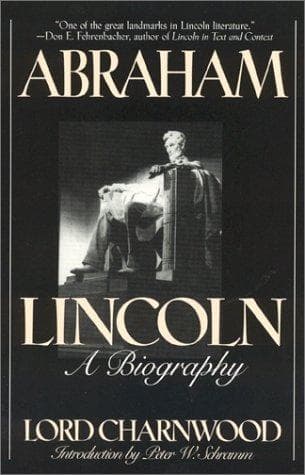
Abraham LincolnCharnwood, Godfrey Rathbone Benson, Baron
History
Abraham Lincoln
Charnwood, Godfrey Rathbone Benson, Baron
Lincoln, Abraham, 1809-1865; Presidents -- United States -- Biography
itself, and the Northern forces could freely move along its western shore
to the impregnable river face of Vicksburg beyond. But the question of
how to get safely to the assailable side of Vicksburg presented
formidable difficulty to Grant and to the Government.
Grant's operations began in November, 1862. Advancing directly southward
along the railway from Memphis with the bulk of his forces, he after a
while detached Sherman with a force which proceeded down the Mississippi
to the mouth of the Yazoo, a little north-west of Vicksburg. Here
Sherman was to land, and, it was hoped, surprise the enemy at Vicksburg
itself while the bulk of the enemy's forces were fully occupied by
Grant's advance from the north. But Grant's lengthening communications
were cut up by a cavalry raid, and he had to retreat, while Sherman came
upon an enemy fully prepared and sustained a defeat a fortnight after
Burnside's defeat at Fredericksburg. This was the first of a long series
of failures during which Grant, who for his part was conspicuously frank
and loyal in his relations with the Government, received upon the whole
the fullest confidence and support from them. There occurred, however,
about this time an incident which was trying to Grant, and of which the
very simple facts must be stated, since it was the last of the occasions
upon which severe criticism of Lincoln's military administration has been
founded. General McClernand was an ambitious Illinois lawyer-politician
of energy and courage; he was an old acquaintance of Lincoln's, and an
old opponent; since the death of Douglas he and another
lawyer-politician, Logan, had been the most powerful of the Democrats in
Illinois; both were zealous in the war and had joined the Army upon its
outbreak. Logan served as a general under Grant with confessed ability.
It must be repeated that, North and South, former civilians had to be
placed in command for lack of enough soldiers of known capacity to go
round, and that many of them, like Logan and like the Southern general,
Polk, who was a bishop in the American Episcopal Church, did very good
service. McClernand had early obtained high rank and had shown no sign
as yet of having less aptitude for his new career than other men of
similar antecedents. Grant, however, distrusted him, and proved to be
right. In October, 1862, McClernand came to Lincoln with an offer of his
personal services in raising troops from Illinois, Indiana, and Iowa,
with a special view to clearing the Mississippi. He of course expected
to be himself employed in this operation. Recruiting was at a low ebb,
and it would have been folly to slight this offer. McClernand did in
fact raise volunteers to the number of a whole army corps. He was placed
under Grant in command of the expedition down the Mississippi which had
already started under Sherman. Sherman's great promise had not yet been
proved to any one but Grant; he appears at this time to have come under
Public-domain text, read in full here on John Shaqi.
Reviews
Reviews
No reviews yet
Be the first to share your thoughts on this work.
Elsewhere in the archive
Join the Discussion
Join the discussion
Sign in to leave a comment or review.
Sign InorCreate an account